I am a librarian who works in a post-secondary career center. I want to share some of the work search and business resources that I have found useful in my work. I also manage the Facebook group of the same name for library job seekers.
Office Team completed a survey of HR managers to find the most unusual and unacceptable questions asked by prospective employees during interviews. Asking about nap time, if you can get your birthday off, and what the job is for, are interview no-nos.
I'm not shocked by any of them, but I think some people with interview anxiety may want to know that at least one of their competitors will ask these gems--and not be informed in advance about how grown ups take care of these issues.
As an aside, I don't think the "help me find an apartment" one is a bad one: they may have misunderstood what "relocation assistance" meant in the job posting.
Interview Questions in a Flash is a book of interview flash cards, separable by perforated pages close to the fold of each page, meant to help a person study for their interview. The cards have a question on the front, suggestions for an answer below the question and the flip side has a very short sample answer and lined space for the reader to insert their own notes for an answer. The answers are grouped topically, such as 37 questions on work background, or 27 sample behavioral-situational questions. There is a summary, or index of questions, at the beginning of the book for ready reference.
The front section of the book includes preparation checklists which the person can use to make sure they have all their supplies, or additional items, such as a map of the interview location, which would be very helpful if the candidate needs some help getting organized.
I think this book would be useful for someone who is preparing for an interview and who may also want to reuse answers to questions in an interview. It would also be useful for interview prep, since like regular flashcards, the candidate can give the cards to a partner and the partner can ask a question and evaluate the candidates response. However, the book is not very tough: just rip the perforations apart and keep them in an envelope upon the first use of the book.
Note to librarians: If you are buying this book for your collection, the perforated pages are very sensitive and even a cautious page turning on the first review of this book made at least two pages fall out. This book may be better suited to a kit or as a tool for a seminar on job seeking.
Legal Experts Stress That Social Media Background Checks Create Risks from Workforce Management argues that conducting a Google search on a candidate, not to mention looking at their Facebook profile, is akin to interviewing a candidate. I don't know if I would go that far for public results available from Google, though I do contend, stay out of Facebook for screening.
This argument may be enough to curb the practice:
Employers also should review their liability insurance programs, including employment practices coverage, to make sure they are covered if they are sued by employees or job prospects in connection with the use of social media"
This is also another article that attempts to hammer home the point about mistaken identity when conducting online background checks on candidates.
Good, basic advice. He tells you in two minutes what to do, and then you spend the next two hours prepping.
By the way, I'm not kidding about the two hours of prep time. That should be your minimum amount put into preparing for interviews in general. Then do a refresher with a partner the night before, maybe thirty minutes, to make sure you worked out all of your kinks.
If you have an interview in NY and need to breeze in and breeze out, check out Roomorama which has listings for short term rentals. You can use it to look for an actual room, or if you are comfortable with this option, a couch surf. You can also pay online via PayPal and not worry about bringing lots of cash to a strange place. Listings are currently limited to NY, but the site does promise listings for Boston and Toronto.
You can combine this "cheaper" (really depends on listing and what you can afford) with a discount bus line, for true job seek economy travel.
This interview is supposed to describe a "non-traditional" method of interviewing--going for a walk and coming back for dinner--but it sounds like most academic interview marathons. I like her idea of taking the time to know someone, but here is my problem:
Do I have to accept your food if I am a strict vegetarian? Listen to how she describes it: the meal is all about presentation and fit, still part of the interview. Sounds like I can't abstain.
Now, since I don't eat many shared meals with my co-workers--we have lunch together all the time, but not the same food--this is not really an issue. The last time I looked for work was before I joined the Green Side, so this hadn't been a problem. Now it is: how will I decline the pig on a stick?
Most people will think this is easy. It is not, as most vegetarians will tell you. The reasons that people become vegetarian are usually quite diverse and may be very murky, filled with dark secrets about arteries, could have to do with their religion, or beliefs about peace and nitrates, and, well, I really don't want to explain. Do you really want to hear about my arteries? No more than I want to hear about your Metamucil intake. I just want to say, No thanks, you go ahead. And drink my green tea (though, that's a lie, it would be hi-test black coffee). And not have to answer any more questions about it. I just want to say no.
Vegetarians are not the only people with this problem. Many religions have dietary rules that cross Appleby's off the list of places to go for a chat. You may also be taking out a candidate for lunch during her religion's fast day or period.
You might be able to see where I'm going with this but I'll be clear:
The interviewer just doesn't know about other cultures, religions and their rules.
The interviewer does know and knows she can't ask at the interview, so she is going to see if the candidate passes on the food and the reason for the pass.
Now the nice lady in the video is just trying to find "fit" and is possibly just the jolly Seinfeld cake pusher she appears to be, so I don't think she is Type 2. Type 2 is more insidious, especially if you have to work with a diverse client culture. I should be able to decline politely and move on. What I eat, when, and how, has nothing to do with my job performance.
Do I say skip the meal? Not at all. But I am sure it has come up for others in the past: how do you decline food without insult?
I have put Sway on my list because of the chapter about interviewing, and because I am also reading Predictably Irrational, and I think people who are prepping for interviews should listen to this part on the podcast about interviews.
Done?
The type of interview questions they are talking about are simulations. The idea is that you give the candidate a defined task or a problem to accomplish, correctly, in a set amount of time. Make the column in this spreadsheet add up. Catalog this webpage. Roleplay a reference encounter. Deliver a presentation. These are all examples of simulation questions in a librarian interview, and you should be prepared for them.
You should also be prepared for the ways that interviewers mess them up. The interviewers may not have prepared a scoring guide so they can compare the skills of all of the candidates equally. You may not be perfect, but you should appear trainable--a 2 out of 5 on a difficult simulation with great references is better than a 4 out of 5 with an I would never hire them again reference (some people just give good interview). They may not have tested the question, just taken it from a book, and they are not prepared for the broad range of responses--ones the book didn't tell them to expect. The interviewers also don't realize that if a simulation doesn't have a scale, it needs to have a solution or a goal. Or a mix of both.
If you have claimed to be able to do something--use a program, write or speak another language--you should be prepared for a simulation question to appear on the interview script.
Though librarians are not specifically mentioned in this article, there are some librarians who will be interviewing for tenure track positions and this may be a trend that will affect the whole: moving up the dates for offers (as early as the end of January).
Other trends that will affect interviews:
More telephone and VOIP interviews to deal with the rising cost of paying to fly in candidates.
Need a teaching demonstration? You may be asked to create one and submit it to YouTube. Another way to keep travel costs down.
More interviews at conferences, to do double-duty of networking and recruiting, or a decrease in conference attendance, since money may have to be allocated for increased travel costs. In the latter case, expect more online conferences and less in-person conferences.
Can you think of something else that will, or already has, affected interviews and job offers?
Jobacle had a great short post on eye contact and I thought I would expand on it slightly since eye contact can have ramifications for interviews, as well as on-the-job customer service delivery.
The Jobacle post has some nice basic rules, but there are some cultural rules to be aware of: not all cultures evaluate the quality of eye contact in the same way as North Americans. There are differences between the countries that make up North America, as well as urban/rural, or native Americans or Canadians, and male to female. I have also met some North Americans (more below) who are pretty harsh when evaluating the quality of eye contact, so if you are interviewing for a North American position, but you aren't from around these parts, you might want to get some tips.
1000 Ventures, a business coaching company, has a good article on eye contact in the workplace that takes in culture and psychology. (Ignore the garish colors and forgive some of the typos, it's still a good article.)
VideoJug has a whole section on multicultural manners that includes advice from Norine Dresser, the author of Multicultural Manners. When I teach a session on interviewing and conversation to my ESL students, we usually start with the section in her book about eye contact.
Leila's House of Corrections Eye Contact video has some great explanations for women about the appropriateness of eye contact and how the gaze can occasionally be misread.
If you have concerns about your eye contact and the appropriateness of your gaze, you might want to have a mock interview that is video taped and see how good your eye contact is. Talking with a person from the country where you plan to interview--and, yes, there are differences between the US and Canada (we're not just cooler)--is a good idea.
As an aside, I teach ESL as a volunteer, and I have heard some disturbing stories from my students about getting hassled by law enforcement (train security and city cops) because of their lack of eye contact. Some of the officers have told these students that they look shifty and deceitful. The cops were quite belligerent with the students, when really the student's culture has told him/her to look on people in uniform with respect--not to mention that some countries have notoriously bent cops and it's a good idea to not attract their attention. I'm surprised that this was an issue, but I had a really upset student talk to me about a situation last year that made me think that people in authority--and this includes librarians and HR professionals--should stop acting like hyperactive rottweilers.
The NPR Business Story of the Day, Discounts Help Bus Travel Thrive In Some Cities, talks about some of the cheap discount buses that people are making use of when Amtrak or a plane is just beyond the traveller's budget. If you have to pay your own way to get to an interview, and the city you need to travel to is served, this may be one way to keep your costs down.
Have you ever actually watched yourself on a web camera? When I bought my web camera, I ran some tests to see what the camera could see and GE-AH! you would have to pay me to look at my roundish, shiny self. I can't believe people do this willingly and make kissy faces.
But there are times when you will have to do this unwillingly: distance job interviews or if you deliver programs over the internet with the help of a webcam. WSJ has an article about web presentation etiquette--do you want to be remembered as the person who should have gotten cream for that particular itch?--but I also want to to remind people to get a good look at themselves before they plunk themselves down in front of the camera.
No jammies for this distance interview. They can see your little duckies.
Check the position of your web camera and try not to lean or fidget: cleavage shots do not get library jobs. Ditto, standing up to reach for something and putting your can/ camel toe in the picture.
Are you shiny? This seems really vain, but we are unforgiving about video standards and appearance. Who are we measuring ourselves against? News anchors. Now, we can't all have the calm authority of Lloyd, but a good scrubbing can't hurt. At least they can't smell your breath.
Where are your hands? No, seriously. If you're a hand talker like me, are you jazz handing through your interview? Does it look like they're getting busy below the desk: out of sight hand-wringing can look like illegal fondling. Put little marks on the table, like dancers do for their feet, and make sure you know what your left hand is doing.
Some forgiveness is nice. How many interviewers realize their pores look like nebulae, too? Many people, especially if they are not experienced IM users, just throw themselves down and don't even check what they are actually filming. You scoff, but I know this is true. I have seen their nose hairs.
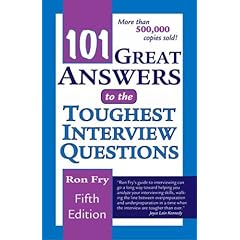
One of my favourite interview books, one that I still use for prep all of the time is 101 Great Answers to the Toughest Interview Questions. They aren't the toughest questions--unless you don't know what BDI questions are. If you don't know what a BDI question is and since most interviews are made up of BDI questions, you might think about having this one on your bookshelf too.
Now in its fifth edition, this book has a formula that I think works really well for first time study of BDI interview questions. The book poses a question, gives you some rationale on how to answer the question and then gives you a "green light" (good) answer and a "red light" (bad) answer. This method gives you a good example to follow and can help you analyze a response that you gave that your interview partner thinks it "bad". Questions are grouped into chapters by the type of information or soft skill the question is trying to get information about.
There is also a substantial first chapter on general interview skills and prep that you might skip if you are pressed for time but you should go back and read it when you have time.
There are other interview books on the market, some even using a similar formula, but I think this one is the best for BDI beginners.
Nick Corcodilos--author of the long-running newsletter, website and book of the same name, Ask the Headhunter--disdains Behaviour Descriptive Interview questions. In his recent foray into blogland, he has even sprung out a hate-on for BDI questions. Though I agree, somewhat, with many of his arguments, like past behaviour doesn't always express future success and that the BDI interview can be rigged in favour of the glib, there is one enormous problem with shedding BDI questions: what else are people going to ask?
Well, more intelligent questions that are trying to elicit information about skills, such as:
Give me an example of a collection development project that you worked on: how did you plan it and what was the outcome. -Or-
Give me an example of a time when you accepted a teaching assignment with very little time to prepare.
Wait, those are both skills-based and BDI questions. Could it be that BDI questions aren't bad but are just selected and delivered by people with little or no interview experience?
I would also beg you not to throw the BDI out with the bathwater since we have scripted interviews for very good reasons:
for the unimaginative, scripts are good
for the grandiose and easily distracted, scripts are better
we need to measure fairly and objectively
an unstructured conversation can also favour the glib
structured interview questions, with rules, also allow the candidate to think logically and reflectively about her presentation and delivery
BDI is part of the proportions of a mix of interview questions, but it shouldn't make up all of the interview questions.
I just finished reading Susan Katz's article on the disparity between mock interviews and how employers actually interview. Here's the story:
Most career service centres offer a mock interview service and the schedule of questions in mock interviews are usually based on research into the professional human resource literature or on actual employer surveys the career centre has conducted. Katz argues that though it is true that many large corporations are using BDI questions, many small organizations--where many grads, and many library school grads may actually get their first jobs--don't use BDI questions. In other words, you will probably work for a library that doesn't have an HR department and who may not use BDI questions. (Academic librarian wannabes, you can wait for the astounding enlightenment to be found in tomorrow's post; all academic libraries have HR departments and tons of BDI questions.)
Based on her action research, Katz has created a handout for her students that helps them, not with BDI questions (and she still includes some sample questions), but with how to tell employers what they should know about the candidate/student who is interviewing for a job.
If you were to do this for yourself, for this posting, your sheet would look like this:
Library science degree
Proof:
One-two years industry experience
Proof:
Customer service
Proof:
Answered "customized" research queries
Proof:
Identified research needs
Proof:
Identified tools clients can use repeatedly and trained them in the use of the tool
Proof:
Shared knowledge with colleagues
Proof:
Explained complex concepts in plain language; these concepts may not represent your field of expertise
Proof:
Provided evidence to support initial research and suppositions
Proof:
Responds in a timely manner to requests
Proof:
Delegated tasks to the appropriate officer/researcher
Proof:
Worked independently and completed projects on time
Proof:
Worked as team member and completed portion of project on time
Proof:
All I did was take the job description and describe what they wanted the person to do. You can also include any specific databases or programs (Lexis-Nexis, for example), if necessary and make your own skills sheet. They are also in past tense since when you write your statement, I would like you to give proof that you have done what you say, not, I'm sure I can do that (aye, aye, Captain Bligh).
If you are interested in Katz's original article, the NACE Journal is only open to NACE members; you may be able able to access it through ProQuest. The citation is below:
Katz, Susan, M. "The Job Interview: Is Career Services Giving Students a Realistic Picture of What to Expect?" NACE Journal. Oct 2007. Vol. 68, Iss. 1, pp. 38-44.
A product of JobSiteUK, Be My Interviewer offers a series of questions posed by "celebrity" specialists from the UK. There are a variety of question themes, such as Killer or Ambition questions, to select from and you can mix and match from the script by selecting from a menu on the lower right side of the page. You can also pick the type of interviewer who you would like to face--I've had interviews in libraries with interviewers like Keith, Kirsty and Jacqueline, and one with a person like Ruth, who seems a lot like her last name--but it would be a good idea to try some different genders and pitches to get used to presentation and tone.
I think this is a useful interview experiment, especially if you can't find someone to help you with a mock interview. Caveat: I don't think some of the questions were well-thought out, or, to get the most from the experience you also have to view the rationale, the Answer. For example: Duncan Bannatyne poses a question about how soon you could accept the job and one of his options is, do you need to speak with your partner? I think this is a despicable ploy to find out about your marital status, and the interviewer asks with such brusque, Trumpian authority that I would feel pressured to answer. I accept the reasoning for the question, provided in the Answer feature, but still, partner or not, NYOB.
I found this on BORN, which I think is a useful site for online recruitment trends in the UK.
WSJ Online has a brief article on some of the silly questions that get asked at interviews: Is that your natural hair colour? Give me a second and I'll check...If you were a dog, what kind of dog would you be? Library cats are far more traditional, but a terrier in the closed stacks...
Some questions are just gaffes, small talk gone hopelessly wrong, but other questions, like the Melrose Place catty natural hair colour question which could be fishing for your age, can become truly inappropriate. Most often the interviewer is as nervous as you are because they have an important job as well: they need to hire someone. And it better be the best person.
Forgive a gaffe and dodge the digs. This information sheet will help you spot improprieties.


 Interview Questions in a Flash is a book of interview flash cards, separable by perforated pages close to the fold of each page, meant to help a person study for their interview. The cards have a question on the front, suggestions for an answer below the question and the flip side has a very short sample answer and lined space for the reader to insert their own notes for an answer. The answers are grouped topically, such as 37 questions on work background, or 27 sample behavioral-situational questions. There is a summary, or index of questions, at the beginning of the book for ready reference.