Showing posts with label review. Show all posts
Showing posts with label review. Show all posts
Monday, April 11, 2011
Creating List-Based Android Apps in App Inventor
If you have been given the task of making a simple android app, like a quiz or a simple inventory, this video will show you how to complete the task using Android App Inventor. The examples are practical and each one builds on the other. The instructional style feels like a tutoring session or a group learning event. This session is really meant for someone with some basic programming skills, such as using if...then.
Some of it might go a little fast (sort of like a cooking show with some mystery ingredients and fast mixing chef) but the advantage to having the video is that you can watch it again. However, with three strong active learning examples that teach practical skills for working in the Android App Inventor sandbox, this is a worthwhile purchase if you are learning how to make your own simple apps.

Friday, February 4, 2011
Crap Detection 101, review
Howard Rheingold, the author of Smart Mobs, looks at several different media literacy issues: determining authority, avoiding scams and getting good information. Crap Detection 101 is also an expansion of an article that he wrote for the San Francisco Chronicle (and which is still available online). He uses examples and tells brief stories to illustrate his point. He is also very kind: he know these topics are difficult and when people are sucked in, they feel stupid, as well as vulnerable.
I would recommend this resource to anyone who is timid about using some of the services on the Internet that make us more efficient, but who is worried, either because of a past mistake or because of the media, that they will be conned. His tips could also be applied to looking critically about corporate information and job scams. Crap Detection 101 may also help Internet risk-takers, though Rheingold's low key manner may not be enough to grab their attention.
I would recommend this resource to anyone who is timid about using some of the services on the Internet that make us more efficient, but who is worried, either because of a past mistake or because of the media, that they will be conned. His tips could also be applied to looking critically about corporate information and job scams. Crap Detection 101 may also help Internet risk-takers, though Rheingold's low key manner may not be enough to grab their attention.
Wednesday, June 3, 2009
Scratch Beginnings: Me, $25, and the Search for the American Dream by Adam Shepard
Adam Shepard read Barbara Ehrenreich's Nickel and Dimed: On Not Getting by in America and had a Gen-Y hissy fit that hard work and gumption could no longer realize the American dream. After college he decided to embark on a year long experience to see if he could make it with just $25 and his own willingness to work. He was determined to find a place to live and have substantial savings, $2500, at the end of his year long experiment.  Scratch Beginnings describes his efforts: living in a homeless shelter, his struggles to find work that wasn't exploitative--his experiences with day labor companies are interesting reading--and to find work that he could do.
I have to admit, I didn't want to like Shepard's book. I find the solution, don't give up, work real, real hard and The Man will make you employee of the month, a bit simplistic. I also found out about this book through John Stossel's The Middle Class is Doing Just Fine, Thank You, which included a very mean-spirited interview with Barbara Ehrenreich stuttering and Stossel pontificating. Yes, the middle class is fine--on credit. And look how that panned out.
What I liked about Shepard's style was his self-deprecation, his willingness to describe his conflicts with his co-workers, which seemed to undermine his efforts to just get along and work hard, and the description of his roommate who exploits Shepard's need to keep his car running. What I found a bit grating was his tendency to hero worship, though he seems to become aware that it is occasionally misplaced. Though I disagree with his conclusion, that hard work alone could get a person out of poverty, but a living wage and some dignity won't. He didn't seem to realize that his parents' illnesses would have derailed his dream--perhaps temporarily, since he seems to be admirably resilient--and that similar repeated setbacks can knock the fight out of anyone.
But the message of his book is to be resilient, to show grit and spirit, and he argues, from his lived experience, that squandering the minimum makes people unworthy of an extra helping. He does make a compelling case that if you stay put, are patient, learn from others, put their wisdom into practice, save money and stay in reasonably good health, then you can begin to realize the "American Dream".
If you can hold on to it isn't included in this book.

 Scratch Beginnings describes his efforts: living in a homeless shelter, his struggles to find work that wasn't exploitative--his experiences with day labor companies are interesting reading--and to find work that he could do.
I have to admit, I didn't want to like Shepard's book. I find the solution, don't give up, work real, real hard and The Man will make you employee of the month, a bit simplistic. I also found out about this book through John Stossel's The Middle Class is Doing Just Fine, Thank You, which included a very mean-spirited interview with Barbara Ehrenreich stuttering and Stossel pontificating. Yes, the middle class is fine--on credit. And look how that panned out.
What I liked about Shepard's style was his self-deprecation, his willingness to describe his conflicts with his co-workers, which seemed to undermine his efforts to just get along and work hard, and the description of his roommate who exploits Shepard's need to keep his car running. What I found a bit grating was his tendency to hero worship, though he seems to become aware that it is occasionally misplaced. Though I disagree with his conclusion, that hard work alone could get a person out of poverty, but a living wage and some dignity won't. He didn't seem to realize that his parents' illnesses would have derailed his dream--perhaps temporarily, since he seems to be admirably resilient--and that similar repeated setbacks can knock the fight out of anyone.
But the message of his book is to be resilient, to show grit and spirit, and he argues, from his lived experience, that squandering the minimum makes people unworthy of an extra helping. He does make a compelling case that if you stay put, are patient, learn from others, put their wisdom into practice, save money and stay in reasonably good health, then you can begin to realize the "American Dream".
If you can hold on to it isn't included in this book.
Monday, March 16, 2009
So what are you going to do with that?
Well, if you're already a librarian--and know that you still want to be one--you will do library-stuff. But for masters and PhD students who are thinking about leaving an academic career--or one of the many librarians who left ABD for library school, and I know a few of you personally--you should spend an evening with this book.
 So what are you going to do with that?: Finding careers outside of academia, revised in 2007, is the project of Susan Basalla and Maggie Debelius. You may have read Susan Basalla's columns in the Chronicle, or seen the authors posting on WRK4US. So what are you going to do with that? helps students and academics with what I think personally is one of their greatest problems: a lack of knowledge of careers outside of academia.
Let me give you an example. If you don't want to do what your parents do, who do you see next as a professional or worker? You guessed it: a teacher. Now, some of us also visited the school library, or spent time with the school nurse (maybe a truant officer) but most of us saw teaching as a noble--and powerful--profession, since they held the chalk.
Then you went to college and ta-dum, you met the professor who controlled the PowerPoint and drank beer in the off-hours like a normal person. At the same time, you either a) worked crap jobs that you didn't want to do for the rest of your life; b) gave into your parents and got a degree in something that was supposed to lead to a job; or c) asked around or read a book about some other options. Many of us did not do complete part c before going to graduate school, so now we know very little about jobs, occupations and professions. So what are you going to do with that? is part of option c, which all of us in college should do--yes, read a book about careers. Now is the time!
Anyway, back to the book. Basalla and Debelius provide profiles (including Todd Gilman, a librarian who has also written for Chronicle about library and librarian stuff) of what former academics have done since departing from academia. They provide advice on how to research careers, including one of the best recipes for information interviewing, and even some sample resumes. Quotes from former academics and their advice on how to leave academia are spread throughout the book, providing evidence for how career management can work for people with advanced degrees.
One of my favorites, which I'll quote here, is from Jennifer Stone Gonzalez, who explains why grad students don't like to network:
In the business world, the most important information flows through people, not texts. Most of what you learn in business comes from informal dialogue, whether in person, on the phone, or via e-mail. This is one reason why people in the business world work so hard to establish interpersonal alliances. People in the business world read so they can cull information for us in conversations that fuel this exchange of learning and solve practical problems (p.79).
The emphasis is not on solitary analysis but on information sharing--which librarians learn to do and begin to like to do. See, you can network.
So what are you going to do with that? provides basic career management advice and resources, both print and online, that you can use to begin to acquire more occupational knowledge. If you're a graduate student about to leave the papered nest, you should read this book.
 So what are you going to do with that?: Finding careers outside of academia, revised in 2007, is the project of Susan Basalla and Maggie Debelius. You may have read Susan Basalla's columns in the Chronicle, or seen the authors posting on WRK4US. So what are you going to do with that? helps students and academics with what I think personally is one of their greatest problems: a lack of knowledge of careers outside of academia.
Let me give you an example. If you don't want to do what your parents do, who do you see next as a professional or worker? You guessed it: a teacher. Now, some of us also visited the school library, or spent time with the school nurse (maybe a truant officer) but most of us saw teaching as a noble--and powerful--profession, since they held the chalk.
Then you went to college and ta-dum, you met the professor who controlled the PowerPoint and drank beer in the off-hours like a normal person. At the same time, you either a) worked crap jobs that you didn't want to do for the rest of your life; b) gave into your parents and got a degree in something that was supposed to lead to a job; or c) asked around or read a book about some other options. Many of us did not do complete part c before going to graduate school, so now we know very little about jobs, occupations and professions. So what are you going to do with that? is part of option c, which all of us in college should do--yes, read a book about careers. Now is the time!
Anyway, back to the book. Basalla and Debelius provide profiles (including Todd Gilman, a librarian who has also written for Chronicle about library and librarian stuff) of what former academics have done since departing from academia. They provide advice on how to research careers, including one of the best recipes for information interviewing, and even some sample resumes. Quotes from former academics and their advice on how to leave academia are spread throughout the book, providing evidence for how career management can work for people with advanced degrees.
One of my favorites, which I'll quote here, is from Jennifer Stone Gonzalez, who explains why grad students don't like to network:
In the business world, the most important information flows through people, not texts. Most of what you learn in business comes from informal dialogue, whether in person, on the phone, or via e-mail. This is one reason why people in the business world work so hard to establish interpersonal alliances. People in the business world read so they can cull information for us in conversations that fuel this exchange of learning and solve practical problems (p.79).
The emphasis is not on solitary analysis but on information sharing--which librarians learn to do and begin to like to do. See, you can network.
So what are you going to do with that? provides basic career management advice and resources, both print and online, that you can use to begin to acquire more occupational knowledge. If you're a graduate student about to leave the papered nest, you should read this book.
Thursday, January 29, 2009
Step-by-Step Resumes , Book review
The author, Evelyn Salvador, is a professional resume writer with over 15 years experience in the field. Her background is in advertising and preparing business copy.
When it comes to resume writing, I'm a fan of worksheets. If you have a patron who is struggling with writing a resume, a book of samples is not going to cut it: always recommend a book that has samples and work sheets. Samples are for people who have completed their resume, but are struggling with some formatting issues, or who have never seen a resume before.
This book, as well as the accompanying CD-ROM, is chock-full of them. For a person who is struggling with what to say in a resume and how to put their accomplishments into writing, a worksheet is one of the best methods. By using the templates on the disk, the reader could work through the exercises and then cut and paste their work into their resume. The templates can be reused when revising your resume to look for a new position. Librarians would easily be able to use the worksheets for administration, customer service, marketing, creative work, service (especially for reference librarians) and sales, with minimal rejigging for library jargon. If you are struggling with writing a Highlights of Qualification section, or a Career Objective or a Summary, this book has some of the best basic advice on writing these sections, starting with some basic cloze exercises, that I have ever found.
Drawbacks: there is a strong emphasis on business and administrative positions and not so much on educational positions, so the wording sometimes sounds too much like a sales pitch. The sample resumes are also over-produced with serious design flaws (like putting a person's name in white font in a black box, a big no-no for a resume that will be scanned and searched) making them look more like menus than resumes.
However, the advice is pretty good on the whole, and work sheets (yes, I love them) are essential in helping you create an easily retrievable record for what you have done in school, while as an intern, in a practicum and in the work place, which means some of the work you do for creating your resume can also be used when articulating your accomplishments in an interview. Recommended for personal use, not for workshops because it states clearly on each page that the material is not for duplication.
When it comes to resume writing, I'm a fan of worksheets. If you have a patron who is struggling with writing a resume, a book of samples is not going to cut it: always recommend a book that has samples and work sheets. Samples are for people who have completed their resume, but are struggling with some formatting issues, or who have never seen a resume before.
This book, as well as the accompanying CD-ROM, is chock-full of them. For a person who is struggling with what to say in a resume and how to put their accomplishments into writing, a worksheet is one of the best methods. By using the templates on the disk, the reader could work through the exercises and then cut and paste their work into their resume. The templates can be reused when revising your resume to look for a new position. Librarians would easily be able to use the worksheets for administration, customer service, marketing, creative work, service (especially for reference librarians) and sales, with minimal rejigging for library jargon. If you are struggling with writing a Highlights of Qualification section, or a Career Objective or a Summary, this book has some of the best basic advice on writing these sections, starting with some basic cloze exercises, that I have ever found.
Drawbacks: there is a strong emphasis on business and administrative positions and not so much on educational positions, so the wording sometimes sounds too much like a sales pitch. The sample resumes are also over-produced with serious design flaws (like putting a person's name in white font in a black box, a big no-no for a resume that will be scanned and searched) making them look more like menus than resumes.
However, the advice is pretty good on the whole, and work sheets (yes, I love them) are essential in helping you create an easily retrievable record for what you have done in school, while as an intern, in a practicum and in the work place, which means some of the work you do for creating your resume can also be used when articulating your accomplishments in an interview. Recommended for personal use, not for workshops because it states clearly on each page that the material is not for duplication.
Tuesday, January 27, 2009
Same Day Resume, book review
Same Day Resume is part of the Help in a Hurry series from JIST, which includes Next-day Salary Negotiation and Next-Day Job Interview, which are meant to train people with limited time in necessary job search skills. The author, Michael Farr, is also the author of books in the JIST series Top Jobs for... and Best Jobs for..., as well as the forthcoming 15 Minute Cover Letter book.
This book is for people who have never written a resume before, or who have not written a resume in a long time. It covers the basic formats for resumes--chronological, functional (called skills-based in this book)--and provides work sheets to create your own resume, as well as a wide variety of samples produced by professional resume writers for job seekers in several industries and varying levels of experience. I would recommend this book to someone who is struggling with writing their resume--not sure what format, why use certain techniques and styles--or if you were just looking for a resume bootcamp book. To get the most out of it, you need to fill out the work sheets and use them to create a resume. Fill them out in pencil because you will use this book and work sheets more than once. The book also has a great table of contents and a good index, which means you could easily recommend it to a patron for a quick peek.
On the minus side: no librarian resumes, so a librarian would need to supplement this book with another that has some professional librarian samples. Another negative: too many functional resumes which many employers consider to be deceptive or too text heavy. That aside, just a really great book if you are struggling to put together a resume, or as a supplement to a resume writing course.
This book is for people who have never written a resume before, or who have not written a resume in a long time. It covers the basic formats for resumes--chronological, functional (called skills-based in this book)--and provides work sheets to create your own resume, as well as a wide variety of samples produced by professional resume writers for job seekers in several industries and varying levels of experience. I would recommend this book to someone who is struggling with writing their resume--not sure what format, why use certain techniques and styles--or if you were just looking for a resume bootcamp book. To get the most out of it, you need to fill out the work sheets and use them to create a resume. Fill them out in pencil because you will use this book and work sheets more than once. The book also has a great table of contents and a good index, which means you could easily recommend it to a patron for a quick peek.
On the minus side: no librarian resumes, so a librarian would need to supplement this book with another that has some professional librarian samples. Another negative: too many functional resumes which many employers consider to be deceptive or too text heavy. That aside, just a really great book if you are struggling to put together a resume, or as a supplement to a resume writing course.
Monday, January 26, 2009
How to Say it on Your Resume, book review
How to Say it on Your Resume is part of the How to Say It series which tackles common business writing or business communication issues.
On the plus side, this book has plenty of samples for college-educated job seekers, especially more mature job seekers, people with plenty of job experience and miles between them and their post-secondary education. Each sample is introduced by a case, such as Sally Seeker is a comeback mom with a four year gap, an MBA, who is currently underemployed, and a before and after version of the resume.
On the minus side, the reader would need to recognize what their career issue is--they're a job hopper or have a gap that they need to account for--to realize which case suits them. There is also a layout problem with the before and afters: it would help to have them on facing pages so the reader can see the changes. And the font! I needed my magnifying sheet to read the typeface (I'm old, but not that old) to take a look at the changes. Each of the samples is virtually identical and there is no commentary about why some of the changes were made, though the afters do look better. There is no table of contents that identifies what type of position or industry the resume sample is for, meaning that this is a generic Jane Jobseeker book. The three sample cover letters, heavy on autobiography and light on how to write to fit an organization, just made me groan.
If you knew exactly what your career issue was--a gap, job hopping, not sure how to transfer between industries--and you were a college-educated professional, I would take a look at some of the samples. The lack of a table of contents--though there is a good index--and limited advice on why changes were made mean that this book is not my first choice to give to a patron who says they haven't written a resume in a while. This book might be helpful to a professional resume writer.
On the plus side, this book has plenty of samples for college-educated job seekers, especially more mature job seekers, people with plenty of job experience and miles between them and their post-secondary education. Each sample is introduced by a case, such as Sally Seeker is a comeback mom with a four year gap, an MBA, who is currently underemployed, and a before and after version of the resume.
On the minus side, the reader would need to recognize what their career issue is--they're a job hopper or have a gap that they need to account for--to realize which case suits them. There is also a layout problem with the before and afters: it would help to have them on facing pages so the reader can see the changes. And the font! I needed my magnifying sheet to read the typeface (I'm old, but not that old) to take a look at the changes. Each of the samples is virtually identical and there is no commentary about why some of the changes were made, though the afters do look better. There is no table of contents that identifies what type of position or industry the resume sample is for, meaning that this is a generic Jane Jobseeker book. The three sample cover letters, heavy on autobiography and light on how to write to fit an organization, just made me groan.
If you knew exactly what your career issue was--a gap, job hopping, not sure how to transfer between industries--and you were a college-educated professional, I would take a look at some of the samples. The lack of a table of contents--though there is a good index--and limited advice on why changes were made mean that this book is not my first choice to give to a patron who says they haven't written a resume in a while. This book might be helpful to a professional resume writer.
Monday, May 5, 2008
Best Interview Book, Ever
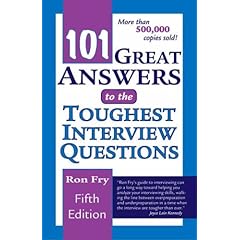
One of my favourite interview books, one that I still use for prep all of the time is 101 Great Answers to the Toughest Interview Questions. They aren't the toughest questions--unless you don't know what BDI questions are. If you don't know what a BDI question is and since most interviews are made up of BDI questions, you might think about having this one on your bookshelf too.
Now in its fifth edition, this book has a formula that I think works really well for first time study of BDI interview questions. The book poses a question, gives you some rationale on how to answer the question and then gives you a "green light" (good) answer and a "red light" (bad) answer. This method gives you a good example to follow and can help you analyze a response that you gave that your interview partner thinks it "bad". Questions are grouped into chapters by the type of information or soft skill the question is trying to get information about.
There is also a substantial first chapter on general interview skills and prep that you might skip if you are pressed for time but you should go back and read it when you have time.
There are other interview books on the market, some even using a similar formula, but I think this one is the best for BDI beginners.
Subscribe to:
Posts (Atom)