Thursday, March 7, 2013

Thursday, February 28, 2013
Yahoo! says no more working from home: Is this really about telecommuting?
Yahoo! has said no more working from home, "all hands on deck" and suggests that if you can't interact with other people, you can't innovate.
I find this interesting since, I would argue, that inspiration was private, but now our new keyword is innovation, which requires a team. Can you really only come up with new ideas in a group--or are we really arguing that the execution of ideas requires a team effort that has to happen over coffee (and not over Skype)? What do you think?
Thursday, February 21, 2013
Can I take a nap during the day?

Office Team completed a survey of HR managers to find the most unusual and unacceptable questions asked by prospective employees during interviews. Asking about nap time, if you can get your birthday off, and what the job is for, are interview no-nos.
I'm not shocked by any of them, but I think some people with interview anxiety may want to know that at least one of their competitors will ask these gems--and not be informed in advance about how grown ups take care of these issues.
As an aside, I don't think the "help me find an apartment" one is a bad one: they may have misunderstood what "relocation assistance" meant in the job posting.
Friday, February 8, 2013
Maybe you should make yourself less anonymous on LinkedIn
This video from Business Insider, How to see who's viewed your profile on LinkedIn, explains how to make your profile anonymous to people whose profiles you have checked on LinkedIn. Personally, unless you are engaged in some sort of corporate intelligence investigation, I think you should be as open as possible (within the confines of LinkedIn).
Thursday, January 31, 2013
Generation Jobless tonight on CBC Doc Zone
Generation Jobless talks about youth unemployment in Canada and it will be airing on Doc Zone this evening. I'm looking forward to viewing the documentary, but I'm also going to bear in mind some of the concerns expressed by the Globe and Mail's TV critic, John Doyle.
Currently, this video is only available for viewing in Canada.Tuesday, January 29, 2013
Putting Tumblr in your Reader
Yesterday, I delivered a presentation to my colleagues on Twitter, Tumblr and Prezi. The presentation introduced the service and what they did and how we can use them.
However, I didn't really talk about how to keep track of them or how to keep them organized after you subscribe. For now, I'm going to focus on Tumblr blogs and managing them with Google Reader, since you can use a similar method for Prezi and Twitter (which is still doable in an RSS Reader, but a teeny bit of a pain to configure). This is not the only method, but our office uses Gmail, so we have Reader enabled. This is a simple method to use to keep track of Tumblr feeds without signing up for Tumblr.
Sign in to your Goggle account and activate Reader from the More menu if you have not yet turned on Reader. This RSS reader will be associated with your Gmail account, and you can use it to monitor news, Tumblr feeds, Twitter feeds, and searches that you monitor as RSS feeds.
To put a Tumblr feed in your Reader, you need to get the RSS feed for the Tumblr. For this demonstration, I got the RSS feed from the Tumblr Dead Man Talking (thanks to Science On! for putting together the listing of science Tumblrs).

Click on the RSS feed button and the RSS feed page will appear. Don't worry about the streams of code: you just need to copy the feed address from the address bar in your browser, as shown below.

Copy this feed (select it and CTRL + C), and return to Reader. Once you are in the Reader dashboard, click on the Subscribe button. The add feed field will appear. Paste your feed into this field and click the Add button.

Once you have clicked the Add button, your feed will appear in the Subscriptions block of Reader. You are now subscribed to the Tumblr feed, so you can access it from Reader, with all of your other feeds, without signing up for a Tumblr account.
You can also create a folder so you can organize all of your feeds by topic. Click on the subscription that you would like to organize--in this case Dead Men Talking, since there is no folder that it belongs to. A menu will appear when you activate the arrow next to the feed. From this menu, select New Folder.

A window will appear with a message that says, What would you like to call this new folder. In this case, I want to keep all of my "science" feeds together--not necessarily my Tumblrs, since I will probably also subscribe to the relevant feeds from Nature, Science Magazine, PopSci Science feed and CBC Technology and Science feed, but I can add those and other feeds later to this folder.
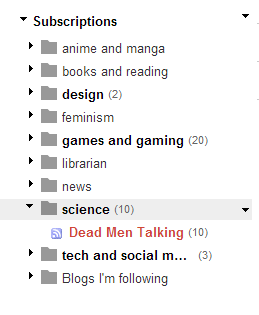
You can see that the feed is now in the appropriate folder. When I add new feeds, I can click on the arrow next to the feed and move it into the appropriate folder.
The numbers next to the bolded folders tell you how many new or unread items are available in the folder.
You can also reassign a feed to a different folder by activating the menu through the arrow next to the feed, or you can perform a mass reorganization by activating the arrow menu next to Subscription and selecting Manage Subscriptions.

You can then change folders, rename feeds and mass reassign feeds to folders from the Subscription management dashboard. Once you are finished, select Back to Google Reader to return to your subscribed feeds.

This method will work with any properly formatted RSS feeds, including Tumblrs, and is a way to follow feeds and keep them organized without subscribing to Tumblr.
However, I didn't really talk about how to keep track of them or how to keep them organized after you subscribe. For now, I'm going to focus on Tumblr blogs and managing them with Google Reader, since you can use a similar method for Prezi and Twitter (which is still doable in an RSS Reader, but a teeny bit of a pain to configure). This is not the only method, but our office uses Gmail, so we have Reader enabled. This is a simple method to use to keep track of Tumblr feeds without signing up for Tumblr.
Sign in to your Goggle account and activate Reader from the More menu if you have not yet turned on Reader. This RSS reader will be associated with your Gmail account, and you can use it to monitor news, Tumblr feeds, Twitter feeds, and searches that you monitor as RSS feeds.
To put a Tumblr feed in your Reader, you need to get the RSS feed for the Tumblr. For this demonstration, I got the RSS feed from the Tumblr Dead Man Talking (thanks to Science On! for putting together the listing of science Tumblrs).

Copy this feed (select it and CTRL + C), and return to Reader. Once you are in the Reader dashboard, click on the Subscribe button. The add feed field will appear. Paste your feed into this field and click the Add button.

Once you have clicked the Add button, your feed will appear in the Subscriptions block of Reader. You are now subscribed to the Tumblr feed, so you can access it from Reader, with all of your other feeds, without signing up for a Tumblr account.
You can also create a folder so you can organize all of your feeds by topic. Click on the subscription that you would like to organize--in this case Dead Men Talking, since there is no folder that it belongs to. A menu will appear when you activate the arrow next to the feed. From this menu, select New Folder.

A window will appear with a message that says, What would you like to call this new folder. In this case, I want to keep all of my "science" feeds together--not necessarily my Tumblrs, since I will probably also subscribe to the relevant feeds from Nature, Science Magazine, PopSci Science feed and CBC Technology and Science feed, but I can add those and other feeds later to this folder.
You can see that the feed is now in the appropriate folder. When I add new feeds, I can click on the arrow next to the feed and move it into the appropriate folder.
The numbers next to the bolded folders tell you how many new or unread items are available in the folder.
You can also reassign a feed to a different folder by activating the menu through the arrow next to the feed, or you can perform a mass reorganization by activating the arrow menu next to Subscription and selecting Manage Subscriptions.

You can then change folders, rename feeds and mass reassign feeds to folders from the Subscription management dashboard. Once you are finished, select Back to Google Reader to return to your subscribed feeds.

This method will work with any properly formatted RSS feeds, including Tumblrs, and is a way to follow feeds and keep them organized without subscribing to Tumblr.
Wednesday, January 23, 2013
The Untouchables from PBS' Frontline
If you missed it, you can watch it on the PBS website. It does make the DoJ look like the big loser though.
Watch Alarm Bells In The Housing Market on PBS. See more from FRONTLINE.
Tuesday, January 15, 2013
Number of working poor families increases
According to a report from the Working Poor Families Project, the number of working poor families has increased by 200,000 between 2010 and 2011. The report cites such issues as low wage, temporary work, and workers that hold a series of such jobs, and a lack of education--the gap between people who didn't complete high school and those who completed a bachelor's degree is staggering--to prepare people for higher paying jobs.
In 2011, the mean annual earnings for those with a bachelor’s degree or higher were $69,387, compared with $20,936 among those who dropped out of high school (p.4).Other effects noted by the report includes the very high cost of housing for a working poor family, as well as the cost of transportation to work and the cost of child care.
In 2011, 61 percent of low-income working families had a high housing cost burden—defined as spending more than 33 percent of household income on housing costs such as mortgage or rent payments, utilities, and other expenses. For working families below the official poverty threshold, 81 percent had high housing cost burdens.The report also includes a breakdown by state for working poor families in the thousands.
Thursday, January 10, 2013
Do you share the name of an [in]famous criminal?
Here's another reason why it is a good idea to verify by actually meeting with someone--or adding more descriptors to the search than their name--before Googling them: do they share the same name as a criminal?
Just this past week, police in BC alerted the public about a young woman who had been released from prison but who may still pose a threat to people and animals. Now, another young woman, from the same community, has come forward to say, we share the same name, but its not me. I would like to say that it was foresight on the part of this young woman, but more likely she got scared into making the announcement when she was almost arrested on the SkyTrain.
I'm wondering if you did an ego search on yourself and found that you had an evil twin by name, if you should add this info to your application, just so people don't jump to conclusions.
Just this past week, police in BC alerted the public about a young woman who had been released from prison but who may still pose a threat to people and animals. Now, another young woman, from the same community, has come forward to say, we share the same name, but its not me. I would like to say that it was foresight on the part of this young woman, but more likely she got scared into making the announcement when she was almost arrested on the SkyTrain.
I'm wondering if you did an ego search on yourself and found that you had an evil twin by name, if you should add this info to your application, just so people don't jump to conclusions.
Tuesday, January 8, 2013
Mistaken Internet Identity
Andy Elwood, a contributor at Forbes, has apparently been mistaken for the drunken, duct-taped passenger on the IcelandAir Flight, and he has decided to write about it to clear up the confusion.
This is actually something I have warned people about--not that the IcelandAir flight crew apparently has plastic ties on hand to deal with drunks, but that when you do a Google search on someone, that you are correctly matching the face to the name. This is actually one of the reasons why I don't like it when people tell me they searched someone on Google before an interview: they don't know that this is the person that they are deciding to interview, because they have never met them.
Luckily for Andy Elwood, he has a reputable platform where he can dispel the confusion and can refer to the story if there is every a question about his ability to hold his liquor. There are probably many cases of mistaken Internet identity where the person whose name is sullied can't remove the confusion--especially if employers make assumptions before a meeting.
This is actually something I have warned people about--not that the IcelandAir flight crew apparently has plastic ties on hand to deal with drunks, but that when you do a Google search on someone, that you are correctly matching the face to the name. This is actually one of the reasons why I don't like it when people tell me they searched someone on Google before an interview: they don't know that this is the person that they are deciding to interview, because they have never met them.
Luckily for Andy Elwood, he has a reputable platform where he can dispel the confusion and can refer to the story if there is every a question about his ability to hold his liquor. There are probably many cases of mistaken Internet identity where the person whose name is sullied can't remove the confusion--especially if employers make assumptions before a meeting.
Friday, January 4, 2013
Anatomy of an Online [Dating] Scam
Writing for Information Today's LinkUp Digital, Reid Goldsborough details on online dating scam through Plenty of Fish (PoF). He also describes how he was able to find information about the scammer and the where "she" found the content to attempt to seduce him, based on research on the website Pigbusters.
Other resources that you could use if you were planning a fraud awareness program include:
Other resources that you could use if you were planning a fraud awareness program include:
- An FBI report on Online Dating and other Extortion Scams.
- Online, Is Dream Date a Scam? from the Wall Street Journal
- The Privacy Rights Clearinghouse has provided a fact sheet, The Perils and Pitfalls of Online Dating: How to Protect Yourself
- Your local BBB may also have information about scams that were perpetrated locally, as this BBB reported on a scam pulled on a complainant from Nebraska.
- OnGuardOnline also has advice on how to report the scammer, though you should also report the fraudulent posting to the dating site that hosts it. This appears to be what happened in Goldsborough's anecdote, since he reports that the profile went missing on PoF, but by then they were communicating off the site. Good advice to check and make sure the profile is still available while you are flirting online.
According to this article from Fast Company, which quotes IC3, the total (reported) losses from romance scams was fifty million dollars in 2011, and women apparently made up the majority of the victims. With Valentine's Day approaching, this may be a timely subject to address.
Thursday, January 3, 2013
Scams and Swindles: Phishing, Spoofing, ID Theft, Nigerian Advance Schemes, Investment Frauds. How to Recognize and Avoid Internet Era Rip-Offs

 Scams and Swindles looks at a wide array of Internet fraud, from phishing and spamming to sweetheart scams. Since many of these frauds rely on the victims not realizing that the information is false, it is important for librarians to learn about different types of frauds so they can recognize them. Librarians may help their patrons to recognize frauds, but may be responsible for recognizing when a fraudster has targeted the library. Scams and Swindles is a good introduction to Internet fraud.
In each section, the author lays out the basics of the fraud, the identifiable symptoms, and then describes a criminal that engaged in the fraud. Each chapter closes with the steps an individual consumer can take to protect themselves and/or to report the crime to the appropriate authorities.
Libraries could be targeted as repositories of personal information which could be exploited by identity thieves. The author breaks down the five institutions that could be targeted for identity theft: incautious businesses that don't have good auditing procedures in place; careless organizations that let their customer data go missing; data thefts from educational institutions; data brokers who store personal records; third-party credit and debit processors; and insiders who perpetrate a fraud (p.6). The steps the author suggest to combat losing personal data include "The Four A's: authentication, authorization, administration and audit"(p.23), which is a simple outline to build a data security strategy on.
Though this book is almost ten years old, most of the frauds are ageless, or can be easily reincarnated. However, some of the websites mentioned in the book, as well as some of the legislation, has changed. In this case, Scams and Swindles is a good book for recognizing fraud, but not for combating it, though identification may keep many people from being scammed in the first place, which is the most important part of the battle.
I would recommend this for basic research into Internet fraud, especially if your library was planning an awareness program, but not as the comprehensive resource on the subject. The book also does not touch on job scams, though many of them are perpetrated as cash advance and spoofing scams. The book's accessible and plain language style will also appeal to readers who have limited financial or computer experience.
Subscribe to:
Posts (Atom)