Tuesday, April 15, 2008

Come and get me: Using a headhunter

Headhunter, search firm, recruiter, temporary agency-- they are not really synonymous, but they do describe a similar purpose: they receive an assignment from an employer with a job opening and they try to fill it. Some work from their available candidate pools, filling relatively low-skilled positions, to others who have rolodexes of extremely versatile and talented execs who they may be able to finesse into the position. Their services vary based on the needs of the company and many of these firms specialize by industry or salary range. Some may offer additional HR services, such as payroll or reference checking, to organizations that have a hiring relationship with them.

Are there librarian headhunters?

Sort-of. Correctly, there are firms that work to fill a variety of positions in the library: clerk, administrative assistant, for example. There are other firms that fill senior level positions, such as branch manager, when a personal touch may be needed to encourage a candidate to apply. A library may have decided to use a recruitment firm because it is hard to fill positions--don't scoff, rural libraries or libraries in less desirable locations or even libraries that have outsourced their HR may have a hard time staffing positions and need to use a recruitment firm. So, yes, you as a librarian can use a recruitment firm.

But you need to do your research first:
  • Find a recruitment firm that specializes in libraries. There are a few out there. Check the job postings and start looking at the websites of recruitment firms that are listed. Are there positions available that you can apply for? Do they attend any career fairs where you could meet with them in person and ask them about tailoring an application package?
  • You need to pick a recruitment firm that matches with your position. If you are trying to get in with a Fortune 500 company that has a library, look for a recruitment firm that assists Fortune 500 companies; if you want one that deals with academic libraries, look for those firms. Be specific.
  • Know what you want to do. I know that seems silly--you want to be a librarian. What kind? Where? Who for? With what duties? Can you do those things or do they seem like something you want to do? You need chemistry with the recruiter, but you should be able to make a bond with the position.
  • It takes time. Surprise: there is no time saving when working with a recruiter unless they have called you directly to match with a position. And that only happens if you are on their radar, which means, research, interview and submit application materials.
  • They aren't working for you. The recruiters work for the company that hired them to fill a position. You are important to the equation, yes, but if you have a bad attitude or unrealistic expectations, they can move to the next candidate on the list.
Using a recruitment firm or headhunter is not a time saver, but it can be an important part of your career management--especially if you see yourself moving up the management chain. Think about your strategy for approaching a recruiter and use some of the advice in Joe Borer's article How To Judge A Headhunter, to find the right one.

Monday, April 14, 2008

Similarities between job and house seeking

On the Jobacle blog today, a post compares house hunting with job seeking. The writer identifies certain qualities that the house/job would have--neighbours are to co-workers, price are to co-workers--and shows you how you can create your own "cost" (to employment) comparison. This metaphor might work for some job seekers--and, if you have to move to find work, be conducted as a simultaneous search--but try to keep your mind form drifting to sub-primes and foreclosures as you conduct your searches.

Thursday, April 10, 2008

Should I get a co-presenter?


If you really want to present but aren't sure if you are ready to carry the burden alone, or believe that the reputation of your potential co-presenter may help you get on the roster, should you look for a co-presenter? Maybe. There are pros and cons for a co-presenter:

Pro:
  • Reputation of the co-presenter may help you get a conference slot
  • Provided that your co-presenter is more experienced, you can get some mentorship
  • Is this truly a partnership? Have you worked on this thesis together? If so, you should share
Con:
  • Is this a co-presenter topic or is it all yours? If it is all yours, you should do your best to become the evangelist for your own ideas
  • Speaking as a practiced blowhard, the more experience you have, sometimes the more right you feel to dominate. I mean: will your more experienced co-presenter steal the show and make you look like a Rosencrantz to his Hamlet? I also may not be able to help it: with my co-presenter whining about how terrified she is, it just makes me all momma-bear maternal and junk.
I would, however, not decide to get a co-presenter as a way to bolster your own courage. If you think the lions are going to eat you, you need to figure out how to transform them into lambs. You do not want to be perceived as the weak link in your presentation, since this will make it difficult to capitalize on the triumph of the presentation. If courage is the issue, there are other ways to get some...and I don't mean Dutch courage. That could lead to a whole 'nother issue.

Wednesday, April 9, 2008

ACRL posted a call for proposals

With lots of lead time and a request for "edgy" proposals, if you have any research or "crystal ball gazing" topics, I think you should consider applying.

Submit a proposal for 2009 ACRL National Conference

The ACRL National Conference Executive Committee invites proposal submissions for its 14th National Conference to be held in Seattle, March 12-15, 2009. The ACRL 14th National Conference offers a forum for an exciting and energizing exchange of ideas on research, practices, developments, and visions in the field of academic and research librarianship. The conference theme, "Pushing the Edge: Explore, Engage, Extend," reflects the promise and the challenge of the Northwest. The ACRL National Conference Executive Committee invites submitters to send their edgiest, most "out-there" proposals, to help make ACRL 2009 a truly groundbreaking conference!

Proposals are sought for a variety of formats including contributed papers, panel sessions, preconferences, workshops, poster sessions, and roundtable discussions. Deadlines for proposal submissions are as
follows:
  • May 12, 2008 - Contributed papers, panel sessions, preconferences, and workshops
  • October 20, 2008 - Poster sessions
  • November 23, 2008 - Roundtable discussions

Full text of the Call for Participation is available online at www.acrl.org/seattle (Click "Proposals"). Complete details about the conference are online at www.acrl.org/seattle.

ACRL is a division of the American Library Association (ALA), representing more than 13,000 academic and research librarians and interested individuals. ACRL is the only individual membership organization in North America that develops programs, products and services to meet the unique needs of academic and research librarians. Its initiatives enable the higher education community to understand the role that academic libraries play in the teaching, learning and research environments.

Tuesday, April 8, 2008

Guest conference blogger

I would love to go to the CLA conference this year, but I have a scheduling conflict and I can't make it. Is someone interested in guest blogging at the conference? I would put your posts here and make links to your own blog, boosting our google juice.

What you would need:
  • Ability to send an email, from one of the labs or from your blackberry to me with your posts
  • I would prefer a mad picture taker, so someone with a cell phone camera and the trigger finger of a fan girl at a con would be most appreciated.
  • You're looking for a job at the conference. The job seeker's perspective at a conference is different from a conference attendee.
Send me an email if you are interested. I will try to think up a worthy honorarium.

Monday, April 7, 2008

How to present at a conference


The first time I had the opportunity to present at a conference, I was asked to present. In my area, we have a technology conference for librarians (Netspeed) and my presentation was one of three student presentations that were selected for that year. I was really excited, since it would be my first opportunity to present but I was also excruciatingly nervous because I was a terrible public speaker. I prepped my slides, asked about the requirements--would I need to bring my laptop? prepare my own handouts?--and showed up in my Sunday-go-to-meetin'/interview clothes.

I was abysmal.

But I learned a lot from the presentation: the importance of rehearsing (I did hours and hours worth, but I hadn't practiced my skillz enough yet, so my presentation was lacking), how to deal with a crowd and answer questions. I also saw that many other presenters were plagued by the same anxieties that I experienced, but that many attendees were very gracious and kind. (They can also be cut throat and mean, but these are the rare few, so don't get knicker-twisted about them.) I also learned that I would have to practice my public speaking: twenty hours on the topic but not dealing with my anxieties wasn't enough. I have since presented at almost ten other conferences, not to mention other events and workshops, and have improved each time.

Beyond a sentence on your resume, there are enormous benefits to presenting at a conference:
  • Presenters usually get to attend the conference for free. Since conferences usually include a career fair, you score 1000 bonus points for getting the Big Boss.
  • Most conferences have a website where past presentations are stored. This does wonders for your Google juice.
  • If you have good evaluations, you can keep them and add them to your portfolio. If you have bad ones, you can burn them and dance around them chanting, whatever turns you on.
  • You can add your presentation to your personal portfolio.
You can get on a conference panel how I got on a panel: I was asked. This is the nicest strategy for a rookie since they will help you with some of the most difficult aspects of getting on the itinerary--applying on time and getting accepted--but, wallflower, I advise not waiting for an invite. Look at some of the conferences where you could speak and apply--prior to the deadline. You can also visit some of your professors and ask about upcoming conferences and ask them if you feel some of you topics would suit/be adaptable for the conference.

Most deadlines for presentation submissions are about 2-3 months before the conference takes place and the bigger the conference the longer the lead time. If there is no extended call for submissions, do not apply. The deadline is the deadline, especially for big conferences. Keep looking for a suitable venue for your topic and find another way to express yourself professionally.

A presentation is, of course, the brass ring, but a poster presentation or a place on a panel is just as worthy--especially if you are an unknown quantity. It would be great if there were more slots reserved for students and invitations sent out generally on the new librarian list serve suggesting that students apply. It isn't enough to ask professors to suggest students--they seem to keep tapping the same students each time they get an email. Maybe conference organizers will see my plea and respond. Heck, most libraries collect comic books, so someone listened to my pathetic begging.

For upcoming library-related conferences, check out the page compiled by Marian Dworaczek from the University of Saskatchewan, as well as ALA and CLA, of course. And don't talk yourself out of it with, no one will want me. Apply.

How to stand out


We all want to enhance our resumes and make ourselves stand out from the pack. Usually, you stand out because you have library experience or you match the position exactly. If you don't want else can you do to make yourself stand out from others in the pile?
During the next week, we'll look at how to get one of these credits on your resume.

Friday, April 4, 2008

Videos TGIF

I had a personal emergency yesterday, so I didn't have much time to think of a stellar post. Instead: video Friday. TGIF all.

The book trailer for Johnny Bunko, the book I reviewed yesterday.


Johnny Bunko trailer from Daniel Pink on Vimeo.

And a little workplace humor, online identity vs F2F (first seen on Jobacle). Beware profanity, so don't be checking this at a public terminal.

Thursday, April 3, 2008

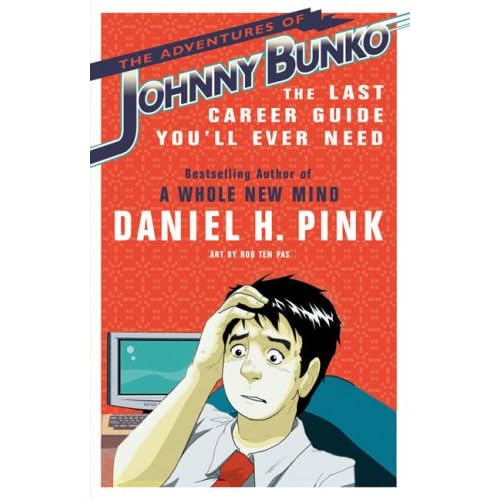
Adventures of Johnny Bunko


Johnny Bunko is stuck in a dead-end job at BOGGS, hopelessly examining spreadsheets for minute errors and doing things that he hates doing...but doing the things that his parents, advisors and career books told him to. One night, slaving late over spreadsheets, Johnny goes to a mysterious sushi house and picks up some chopsticks that, when opened, release his Elfquest style guide, Diane. Diane has a plan and enough mojo to get Johnny where he needs to be to experience her six steps to career fulfillment. If Johnny can pay attention, follow them and not implode at BOGGS.

Described as the "last career guide you'll ever need", I was pretty skeptical since I read quite a few career books. Actually, it is the last career guide that you'll ever need, provided that you follow the book's extra suggestions, and well, actually try to experience the advice. I really liked the 6 steps and I think that many people, especially people in service careers, will really appreciate the last step and it will help them give meaning to their plans. I also loved the manga aside jokes and, as a manga reader, I liked the OEL feel of the book with the Japanese sound effects and references. If you're looking for something to give you some direction and you don't care what colour the parachute is, pick up some chopsticks and visit with Diane and Johnny.

Wednesday, April 2, 2008

Go verbs!

When you're writing your cover letter, you have to rely on the power of verbs to tell your story: what you have done and what you can do. Verbs tell us about abilities and, when used effectively, can provide power for your cover letter.

For example, when applying to this post at McMaster:

I am an effective team player and collaborator on projects, including a proposal for an immersive worlds project.

Too many nouns. Yes, they are in the job description, but you haven't explained what you have done. Collaborator also has some not nice connotations, so watch out for nouns that can have a sinister, or slightly silly, sound.

Try:

For my capping project, I developed a conference in Second Life, a popular immersive world, to introduce librarians to the environment. During the project launch, I trained the initial team of conference volunteers and managed the Help Team which monitored participants and dealt with in-world problems. I also compiled the evaluation data and presented it to the conference organizers.

Yes, the first is stilted and simple and the second has more information, but the verbs are powerful: develop, train, manage, monitor, compile and present. Though the nouns are all present in the first, they don't really explain what you did on the project.

Sometimes, we give up on verbs because they take up so much space because you have to do something with the noun, instead of just, noun, like the toot of a horn. However, verbs do appear in job postings, so you are hitting the keyword high notes, or nouns have a verb form that you can capitalize on. Do more in your sentences: it just gives your paragraphs more power.

If you need help finding so-called action verbs (aren't verbs about an action?) you can use this list from QuintCareers or just do a search in Google for verbs for resumes.

Tuesday, April 1, 2008

What's my name again?


I used to work with a woman nicknamed Rusty who wanted to legally change her name to Rusty. It suited her tuff image. I don't think she put it on her resume though. (I have a better story about that but a family member would probably post a comment about a Christmas tree and underwear; let's not go there).

Many people have more than one name: they are changing their name, getting married or divorced, transgendered, finally fulfilling a lifelong dream of having geeks shout out, "Is it your day off, Ferrous?", or they have an "English name". How do you explain this if your interview coincides with the transition?

On your application documents, you place your current legal name.

If you are getting married, or divorced, and have not completed the name change, it is too soon to start describing to these people, who may never see you again, all of the hyphenated perambulations of your name and what you decided to call yourself, in six months. We watch you guys all the time on Slice and we prefer you behind glass. What is your current legal name?

When you go to the interview, you invite the employer to use your nickname or "English name".

A diminutive, nickname and English name are different:
  • A diminutive is a shortened version of your name: Chris for Christopher or Christina. There is no false intimacy with a diminutive so it is ok to use in the interview but not to put on your application documents, since it is not your legal name.
  • A nickname is used in intimate situations: you're my friend so you have permission to call me by that name. When you start work, tell them your nickname if you always go by that. Howdy Ferrous, welcome to the party.
  • An English name is different and can be given at the interview. It is used for two reasons: one, you have a hard time controlling your wince when an English speaker garbles your name. Two, it is really hard to have people address you by your first name when you are accustomed to an honorific attached to your name, such as Asuka-san, Asuka-sensei or Asuka-chan, depending on the circumstance. An English name lessens the feeling of encroachment. But, it is not your legal name: wait until the interview and introduce yourself with your English name.

Monday, March 31, 2008

Geography of a cover letter


Though it's late to be looking for work for the summer--but not the end of the world! Don't freak out--knowing how to write a good cover letter is a gift that keeps on giving. You will have to write thousands of letters--and emails--in your working career, regardless of whether you stay in libraries or not. You will need cover letters to apply for work, for grants, for positions with the professional association and to shop your work out to publications, just to name a few uses for cover letters.This week, let's talk about how to write cover letters.
  • A cover letter is a business letter writing audition since if you are hired you will write plenty of correspondence for the library. Clean simple business format, no Harry Potter fonts, are important.
  • Your contact information goes at the top. You can use the headers and footers feature to include your contact information, creating a letterhead that you can also use on your resume.
  • The address of the person that you are writing to.
  • The date you wrote the letter on.
  • A salutation: Dear Ms. Manners. If you are not sure about gender and there is no time to call, Dear Kim Manners is fine. You can also use Dear Hiring Manager if there is no name attached. Try to avoid To Whom It May Concern cause it sounds like you will be asking for a ransom.
  • Your first line is a reference to the position and any numbers attached to the position so they know which pile to put your stuff in. (You can send one letter for two postings, since they may be willing to photocopy and place in two separate piles, but you can make it easy for them and send two letters and two resumes. Trust me: if they have two jobs, other people may be handling the screening and interviewing, so someone is going to make two or more copies.) You can also tell them where you saw the posting, since this posting could have been sent to several services which all may have different rules about amount of text allowed or a cost involved depending on the size of the ad.
  • The content depends on you and the posting: how do you relate to the position you are applying for and what projects, from work or school, can you briefly reference that show your suitability in relation to the position.
  • Sign off with the best way to get in touch with you. One way. If it is email, go with email. Don't tell them: I am available every day after 4pm until 5:45 and then I am in yoga, you can reach my voice mail or email or Facebook me during yoga, unless you are really serious about the interview and I will interrupt my Kurmasana to speak to you. Have some faith in the universe: they will leave a message and you will respond.
  • Business letters are usually completed with Sincerely or, if you want to mix it up a bit With regards.
  • 4 hard returns. This is for your signature.
  • Your name, typed out without nicknames.
  • Encl. (2) meaning your additional pages.