Showing posts with label book reviews. Show all posts

Friday, May 16, 2014

What Color is Your Parachute? Guide to Rethinking Resumes - Review

Occasionally, Richard (Dick) N. Bolles will release a sort of special focus guide, such as his books on online job search, that are complimentary to the annual What Color is Your Parachute? Like the other Parachute books, Rethinking Resumes is written in the same clear, plain-language style, updated to reflect the times and concerns of his regular readers and any job seeker. The virtue of this series has always been its clarity, the common sense and pragmatism, and Bolles willingness to update and credit other career and HR professionals for their ideas, which this book also possesses.You can read Rethinking Resumes in an evening, and probably go back in a few months and find something new that you glossed over, and both readings will be worthwhile.

However, there will be a few readers who will pick this book up and wonder A resume book with only one sample? Get over it. Even in resume books with one hundred samples, job seekers still struggle with what to do in their individual case and this book will help answer those questions. The 45 Question Starter Kit (pp. 55-63) is something that I will go over with clients when they have questions about how to write a proper Highlights section.

In addition, there is also plenty of good advice on deciding if you want to hire a resume writer or write your own resume, how to find out if a resume service is a scam, what type of resume to post to a job board and the targetting required to give a resume directly to an employer.

I'm grateful for the section on removing empty keywords and phrases on resumes, as well as the list of stinkers provided, and the process Bolles provides for developing better statements about work experience (pp. 45-47), though I think many job postings are still referring to these phrases as key components while the recruiters who screen the resumes in response those postings are distastefully holding their noses while working through the empty text.

Each year we assign reading to our incoming student staff, and I wish I had got my copy of this earlier so I could add it to our reading list. I think they would have gotten a great deal out of it, and I'm glad it will be available to them in this year. Personally, I would put this next to Why Good People Can't Get Jobs: The Skills Gap and What Companies Can Do About It on my mental bookshelf to recommend to people who are trying to put together a resume that will get them an interview.

Thursday, November 28, 2013

School for Startups, book review

When I first started working in the career centre, and in business librarianship, all small business endeavours that wanted to succeed required a business plan. It was the mandatory task, the one requirement for entrepreneurship. Avoid it at your peril.

Currently, business plans are not required: they are "nice to haves"*--necessary if you are looking for money from a bank or have a class assignment, but no longer the ticket to admission. Now, what is necessary is your idea, a good budget, and a swift move to market. School for Startups: The Breakthrough Course for Guaranteeing Small Business Success in 90 Days or Less, covers these three steps.

School for Startups covers self-employment myths, explains what bootstrapping is and gives the reader encouragement to try some different businesses that might be really, really scary for some people, such as opening an online store or starting an import/export business. Though the book argues that startups can be started for $0, or at least the cost of domain name, some of the businesses mentioned, such as the car export business, cost several thousand dollars to initiate. Again, depending on the type of business the reader wants to found, they will have to supplement their initial reading of this book with more in depth industry research.


If you expect this book to have learning outcomes at the beginning of each chapter with summary questions at the end, School for Startups is not that kind of "course". If I was giving this book to a reader, I would not give it to the reader who has a very strict idea of the type of business they want to operate (I would probably give that person the appropriate volume from Entrepreneur Press' Startup series, or resources from the appropriate professional or industry association), but I would give this book to the person who just doesn't want to work from anyone else, but isn't sure what that involves, except maybe a business loan. This book would also work for the person who wants to try self-employment, perhaps as a summer job or to make their own paid internship, but who isn't sure what they would do, or thinks that they need a grant or business loan to get started.


This book is for:

  • The person thinking about entrepreneurship, but who may not have a specific business idea
  • This is the encouragement book for the reader who has a specific idea, but who thinks that only financing, loans and venture capital will secure their business
  • The reader who is thinking about short term, possibly serial entrepreneurship, creating a business that you can sell to someone else for a profit, which completely matches with the "startup" ethos.

Overall, an enjoyable, quick read, but it does not supplant in depth research.

*Yes, you can disagree with me about the need for business plans.

Tuesday, October 22, 2013

Kickstarter Handbook: Real-Life Crowdfuding Success Stories

Have you thought about running a crowdfunding campaign, specifically on Kickstarter, and wanted to come up with a plan, or at least get an introduction to the platform? The Kickstarter Handbook should be one of the books that you pick up for your research, especially if you have not contributed to a campaign or have only a vague Veronica Mars or Double Fine Adventure vision of how the site works and how much money an entrepreneur can raise on the site.

This book provides a good overview by looking at the platform itself, the types of projects that are eligible for Kickstarter funding and by interviewing actual fundseekers. The author looks at what methods have succeeded and failed. Readers should keep in mind that there is no process or recipe for Kickstarter success and that a project can be snatched from the jaws of defeat with a concentrated final effort--or can fail despite the creator's best efforts and reputation. I also liked the simple worksheets that compared projects and their funding needs based on reward tiers and the actual cost of using Amazon payments and the platform to secure funds. I'm sure that quite a few people who plan to use crowdfunding have confused Kickstarter with an ATM, forgetting that they actually need to deliver--including writing all those emails and mailing labels, not to mention paying the shipping--on all of the rewards they have promised. Don't skip that chapter. I would have liked a chapter on what has happened to people who Kickstarted and didn't deliver, but this is a book about success stories, after all.

The Kickstarter Handbook is a quick read to introduce an entrepreneur to the platform and how it might work for their project. It is not industry or product-type specific, so the reader will have to do additional research into how a designer or a musician can use Kickstarter effectively. The author is a journalist, so it has that Business Insider/Forbes-style of writing, which does make it a  breeze to read; however, it is only the beginning for determining if crowdfunding is the right way to proceed for your project. It may also have insights for the reader who has tried crowdfunding and failed, as well as for the reader who just wants to understand what Kickstarter is and the role it may play in small business finance.

Thursday, August 1, 2013

How to Write a KILLER LinkedIn Profile...and 18 Mistakes to Avoid by Brenda Berstein

At work, we are currently updating our resources on using LinkedIn and shaping our LinkedIn policy. This is one of the books on my reading list on that topic. I originally read about this book in this article from Forbes and decided to pick it up for research, even though we can't use it in our library (available as Kindle book only).

How to Write a KILLER LinkedIn Profile describes eighteen steps, as well as some bonus tips, that you can use to build your LinkedIn profile and increase your likelihood of being found in LinkedIn searches--though the tips could also have an impact on your Google visibility, depending on your LinkedIn privacy settings. Overall, I thought the tips were useful and straightforward and contained enough screen captures that a LinkedIn newbie would be able to find where in the LinkedIn profile the author was directing them to update.

However, this is not a basic book so this is not LinkedIn from the Beginning--and it doesn't have to be. This is written for the LinkedIn user who has a profile but who hasn't made the most efficient use of their content or who hasn't thought about how best to profile their content on and select keywords for LinkedIn. And not everyone is going to agree with all of the tips, such as the recommendation to get more than 500 connections--I accept her reasoning, that the more connections you have, the more likely you are to appear in internal searches in LinkedIn--but I can see some of my hesitant colleagues or clients balk at that. And you don't have to use all of her suggestions to improve your profile overall--making better use of the Summary field and updating at least once a week so your contacts don't forget about you could make an improvement on what you get out of LinkedIn.

I would recommend this one to advisors who have been asked to comment on LinkedIn profiles, but who aren't sure how people make an impact on LinkedIn, coupled with Jason Alba's I'm on LinkedIn...Now What? if you have only cursory LinkedIn experience.

Thursday, April 18, 2013

This is How You Get Your Next Job by Andrea Kay

This is How You Get Your Next Job is about "fit" and how to manage the employer's impressions, or "negative impressions", of your suitability for employment. It is not targeted at any one industry or type of worker, such as professionals or entry-level workers, and though many job seekers will take something of value away from the book, any potential reader who has been told that they didn't get the job offer because of "fit" or for the person about to go for their first skilled-occupation interview.

Overall, the author has offers advice and exercises that will help with interview preparation, such as the list on What employers look for that includes desired qualities such as flexibility, stable behavior and intellectual curiosity, and the Would You Hire You test which includes several essay type questions that will include content you can use for answering interview questions. The encouragement for reflective thinking and self-examination, especially for a person that has had a few failed interview attempts and needs to examine their behavior in the interview, would be helpful for some readers. I would pair this one with Ron Fry's 101 Great Answers to the Toughest Interview Questions, which I like for basic training in interviews.

The author does spend a lot of time focused on the "negative filtering" techniques that employers use to decide who is a suitable candidate. Negative filtering is a cognitive trick used to determine if something is mismatched or incorrect according to our perceptions. In a mild form, negative filtering could mean removing a candidate from the running because they fail to show up wearing a tie. In its most abhorrent manifestation, when a candidate is the wrong religion, race or gender for a job, negative filtering can remove those candidates from consideration, based on the filter of the interviewer. Most of the book focuses on the failure to demonstrate follow through or stable behavior and how those traits are demonstrable and when not achieved how an interviewer can filter candidates out based on the lack of those traits. On the whole, when considering the exercises, candidates can make sure that they demonstrate the traits that employers look for and apply it to their career management.

I did like this book, especially for a reader who is getting ready to enter the professional work force, though I felt demoralized by the litany of employer complaints that sometimes felt frivolous. For example, one interviewer states they would not hire a person who wore patterned hose. Maybe the person meant the airy crocheted kind or fishnets, but this seems to be pretty picky when compared to a person's ability to regularly show up on time and write cogent sentences--not to mention the fact that the patterned salesperson could sell snow to an Inuit. Some of the employer likes and dislikes seemed a little silly when the person's abilities were not considered, but the candidates were discarded for trifling fashion faux pas or some conservative bulwark against tattoos or piercings.

The advice on what to say and not say in an interview, your first presentation to an employer, was really well done, even if some of the picky faults were a bit exasperating at times. I would recommend readers who have the presentation down pat to review the chapter on Things you should never do once you get a job or in your career--ever as a worthwhile introduction to basic career management and etiquette when dealing with colleagues and supervisors. This is How You Get Your Next Job is useful, though it can get a little annoying at times, but it does remind you that interviewers are human too, with their own foibles that candidates need to acknowledge to find employment.

Saturday, August 6, 2011

The Girl's Guide to Homelessness by Brianna Karp

During her homeless year, Brianna Karp chronicled her homeless experience on the blog The Girl's Guide to Homelessness. She was young, educated and according to her own account, had worked for over a decade, even as a teenager, at a variety of jobs that left her with plenty of marketable skills. When she was suddenly laid off from a job that she loved, she was forced to move back in with her parents, though coming back into the household with her abusive mother would not make this a long stay. However, Brianna was resourceful: she was able to use the unexpected inheritance of a trailer and move onto a local Walmart parking lot, find a place to shower and soon a job--though she did remain homeless, she was able to enter a community of homeless activists.

And she also met the man she thought she would marry. A significant portion of the book is devoted to her romance with a man from Scotland who would ultimately abandon her, and in the cruelest of ironies for a homeless activist, abandon her to the elements in the middle of winter. (Yeah, asshole is not quite the word...)

Brianna is remarkably resilient, turning a string of misfortunes into a job, a blog, a book deal and finally finding a stable job, at least at the time of the epilogue, and a place in the homeless activist community.

Caveat emptor: If you have any association with the Jehovah's Witnesses, you may not be happy with Brianna's depiction of the church or their position on several issues, or how she categorizes the group as a "cult"; however, she is basing her description on her experience with the church. I would also like to give a fair warning for the brief depictions of child sexual and physical abuse. These warnings should not scare readers off from the book, especially since I think it is an important book for librarians who have no or limited experience with homelessness, to read, since many homeless people use libraries for places to job search, research and rest, and Brianna's book does put a youthful, educated, female face on homelessness after the recent recession.


Wednesday, August 3, 2011

Malled by Caitlin Kelly

In 2007, Kelly, at that time a freelance journalist, decided to take a part time job in retail so that she would always have some dependable funds in her account for living expenses. When she heard about a new North Face store opening up in a suburban mall, she decided to apply there and despite her lack of experience in retail, but plenty of life and travel experience, as well as fluency in two other languages than English, the management at the new store decided to hire her. According to Kelly, she was a consistent top-seller at her store, and the store that she was employed at was one of the top performing stores for that company.

Kelly's account as a retail salesperson and her examination of the industry focuses on two areas: how poorly retail salespeople are paid and how poorly they are treated by the customers that they are there to help, despite how essential they are to the company and the lipservice that companies pay to the quality of their customer service. She talks about the makeup of the staff at her store: usually minorities (though, minority to who and where? I always wonder), but well educated and ambitious, some with college degrees, others are former military, some are single parents, but they all seemed to be trapped on the retail roller coaster, moving on or up only if they can escape retail. Retail sales is not a career, Kelly argues, you can barely make a living at it, the physical demands are enormous, there is no concern for perfecting a professional salesforce, and the staff just doesn't seem to care--but they would do anything to get out of their retail jobs.

Kelly describes how the corporate focus on the bottom line means that frontline sales staff will remain poorly paid--supposedly shareholders don't want to pay salespeople more, but shareholders are always the villains--and not given adequate tools to perform their jobs. Indeed, the fact that many corporations are apparently clueless about sales, ergonomics, customers and products, is a recurrent theme in the book. The corporate mindset appears as inexplicable and implacable as Kafka's Castle.

A different generation?

I think it may be a generational difference, but I am surprised that she was shocked by how retail salespeople are treated, mainly because almost every person I know has had some experience working in retail as a teenager or young adult. This was Kelly's first experience on the other side of the till (or cash wrap, as she prefers) and at times she appears a little naive at how craptastic a job in retail can be.

She is right about one thing: it is not going to get better for retail workers unless customers stop shopping at stores with crummy service, and who become know for treating their sales associates poorly, as well as for crummy products. And though I liked the book and the immersive journalism, Kelly could have gotten that response from any teenager on their first job--and I would have liked to hear more about how teenagers and young adults can be exploited by this industry, in addition to the few glimpses of mature workers who, after the economic downturn, found themselves working in retail.

I might have enjoyed Barbara Ehrenreich's Nickel and Dimed more, but I still think that Malled is an important part of the immersive journalism literature on workplaces.

Saturday, July 30, 2011

Intern Nation by Ross Perlin


Intern Nation: How to Earn Nothing and Learn Little in the Brave New EconomyIn Intern Nation, Ross Perlin tracks the development of the internship and its implications for labor, especially when unpaid interns replace paid workers, usually engaged in administrative tasks. Perlin begins his discussion by describing the internships offered by Disney--and finds them sadly lacking, if not exploitative, though a typical example of how fall the internship has fallen. He describes the development of the internship, possibly from early guild apprenticeships into their current modern form. Perlin examines the internship labor market in the United States, what makes a quality internship, and some of the characteristics of a demeaning and time-wasting work experience, and the potential rise, and resistance, to the spread of American style internships in the rest of the world.

Perlin also argues that without an internship it is becoming increasingly difficult to pursue the career that a person has gone to college for, such as in journalism, fashion and design, and if you can't work for free for a long period. Parents and loans are increasingly subsidizing students to take on unpaid internships and the cost can be high, considering that some internships can last for a year, could be undertaken in series and offered in places, such as Washington DC, where the cost of living is quite high. And, as others have asked, just who can afford these internships and pay for their children while engaged in these experiences? If it comes down to cost, what about the quality of the interns, if they are not selected based on merit? What does it mean for workplace diversity? And finally, is a college student shut out of their chosen career because they cannot afford to work for free for a long period of time? Perlin's answers are that if internships continues on the path they are on, qualified candidates will be shut out and homogeneity will be a significant issue in the culture and media industries which are currently permeated by free and serial internships.

Perlin sees the internship as part of the increase on the reliance of contingent labor by employers, which others might argue is part of the freedom seeking "free agent nation", and identifies a European term, precarity, to show that internships, and other contingent labor, devalue work and extinguish hope in career security, or the freedom to enter and pursue a career based on the education the person has attained. Internships affect a significant proportion of the population that are pursuing a college education and who believe that a college education will allow them to further their career plans--though many of the signs are showing, as Perlin argues, that without an internship, or three, the value of a college education is diminished, unless the student is in a legally protected profession, from pursuing a white collar career.

There are some minor editing and proofreading issues in the book, but they do not diminish the importance of the argument. Personally, I feel this is an important landmark book on the study of internships.


Authors@Google


From the Advisory: Training and Employment Guidance Letter NO. 12-09
The U.S. Department of Labor’s Wage and Hour Division (WHD) has developed the six factors below to evaluate whether a worker is a trainee or an employee for purposes of the FLSA:

1. The training, even though it includes actual operation of the facilities of the employer, is similar to what would be given in a vocational school or academic
educational instruction;
2. The training is for the benefit of the trainees;
3. The trainees do not displace regular employees, but work under their close observation;
4. The employer that provides the training derives no immediate advantage from the activities of the trainees, and on occasion the employer’s operations may actually be impeded;
5. The trainees are not necessarily entitled to a job at the conclusion of the training period; and
6. The employer and the trainees understand that the trainees are not entitled to wages for the time spent in training.

Further Reading

Employment Law Rights of Student Interns (Abstract).
Intern Nation Author Ross Perlin: Interns Need A Bill Of Rights. The Gothamist
Trickle down unemployment and corporate sleight of hand by James Marshall Reilly, about how  low pay or no pay internships are replacing entry-level employment.
Unpaid Intern, Legal or Not. NYT April 2, 2010

Other Coverage:

Book challenges rise of the Intern Nation. Careers on MSNBC.com (from Associated Press). April 20, 2011.
Canada Turning Into Intern Nation. National Post. June 11, 2011.
Intern Nation. Inside Higher Ed. April 15, 2011.
"Intern Nation": Are we exploiting a generation of workers?. Salon.com. May 29, 2011.
Intern Nation: Overdue And Under-Delivered. Business Insider. May 4, 2011. (Not a favorable review of the book, but left me wondering if the review's author had read more than the first chapter.)
Intern Nation- Review. The Guardian. May 7, 2011. (Includes a story about an auction of  prestigious internships at a political event in the UK.)
Intern Nation- Review. The Observer. May 15, 2011.
Intern Nation - Review. The Telegraph (UK). June 5, 2011.
Intern Nation: How to Earn Nothing and Learn Little in the Brave New Economy

Wednesday, July 13, 2011

Interview Questions in a Flash

Interview Answers in a Flash: More than 200 flash card-style questions and answers to prepare you for that all-important job interview!Interview Questions in a Flash is a book of interview flash cards, separable by perforated pages close to the fold of each page, meant to help a person study for their interview. The cards have a question on the front, suggestions for an answer below the question and the flip side has a very short sample answer and lined space for the reader to insert their own notes for an answer. The answers are grouped topically, such as 37 questions on work background, or 27 sample behavioral-situational questions. There is a summary, or index of questions, at the beginning of the book for ready reference.

The front section of the book includes preparation checklists which the person can use to make sure they have all their supplies, or additional items, such as a map of the interview location, which would be very helpful if the candidate needs some help getting organized.

I think this book would be useful for someone who is preparing for an interview and who may also want to reuse answers to questions in an interview. It would also be useful for interview prep, since like regular flashcards, the candidate can give the cards to a partner and the partner can ask a question and evaluate the candidates response. However, the book is not very tough: just rip the perforations apart and keep them in an envelope upon the first use of the book.

Note to librarians: If you are buying this book for your collection, the perforated pages are very sensitive and even a cautious page turning on the first review of this book made at least two pages fall out. This book may be better suited to a kit or as a tool for a seminar on job seeking.

Thursday, May 26, 2011

Salary Tutor by Jim Hopkinson

This book is forthcoming and will be available for purchase in August 2011. I would like to give a thanks to Netgalley and Grand Central Publishing for making this galley available.

Salary Tutor: Learn the Salary Negotiation Secrets No One Ever Taught You

Learning how to negotiate—for anything, not just salary—is a vital skill, and you will have to use your persuasion and negotiation skills many times in your career.* Negotiating a salary, even your very first salary, is possible and the Salary Tutor explains how to do it in simple, clear, encouraging language. Heck, the author even throws in a flowchart.

I thought the real strength of this book was the preparation of the Industry Research of Salaries (IRS) document, which includes the lowest salary you would accept, the industry standard and the top of the range for the position. The author also includes sources for research (PayScale.com, Glassdoor, Salary.com), though I would also include some of the salary tools from vertical search engines and industry specific salary surveys, if you have access to them, to your research. The author recommends including this document in your portfolio, so it is prepared for interviewers should the issue come up, and to make several different versions of this document. There is nothing like research and preparation for defending your position in a negotiation, so this is not a step to be skipped. Even if you are never allowed to negotiate your salary—which can happen in a union, non-profit or government work environment—it cannot hurt to know if you are making what the position deserves, especially if additional duties are added to your position at a later date.

The author also has some solid advice for freelancers and creative professionals who need to negotiate each and every contract or service for a client, which is not found in many salary negotiation books. So the structure of the book follows: author’s salary memoir, how to negotiate for the first time, negotiating a raise or promotion and negotiating for freelancers. Considering how short the book was, meaning it could be read in an evening, I was impressed with how comprehensive the book was overall.

Since negotiation is important part of career management, I would strongly recommend this book as a simple primer on negotiation. There will be other resources that can supplement the information in this book, but I think it is one of the best introductions to this process that I have ever encountered.

*For librarians, the first time you have to negotiate a discount or a license, you will wish you had spent some time learning how to persuade salespeople to take less from your budget.

Friday, May 20, 2011

Job-Hunter's Survival Guide by Richard N Bolles

The Job-Hunter's Survival Guide: How to Find a Rewarding Job Even When "There Are No Jobs"Richard N. Bolles has produced a Coles Notes version of his famous What Color is Your Parachute? which could be read in an evening and provide the pertinent points from his more well-known work. This booklet includes the well-known "Flower Petal" exercise, as well as some of his basic charts for self-assessment and a discussion of the most effective methods for job search. Not included in this book is his explanation of information interviewing and how to do it.

Though I firmly agree with Bolles that a job search is more effective if the search is targeted and that multiple job search methods are essential to successfully finding a job, I have to disagree with his #4 most successful method for finding a job: going door to door. Now, this will work if you are looking for the kind of employment that does not include a heavily guarded HR office (and any library or academic institution I can think of has at least one HR person), this method will work. It will probably land you a survival job--and if you need one, try this method. However, using his most effective job search method--complete an inventory and know what you are looking for--will lead to a professional job, so it seems petty to quibble with one method. 

Bolles wrote this book to be a short version of What Color is Your Parachute, suited for the recession, for people who need to find a job NOW, and who don't have a lot of time, or money, to spend reading career books for advice. On those grounds, this book is successful and would be useful for a job seeker who needs to make a plan and get job hunting.

Wednesday, May 4, 2011

Career Opportunities in Library and Information Science by Allan Taylor and James Robert Parish

Career Opportunities in Library and Information ScienceCareer Opportunities in Library and Information Science is part of a series of Career Opportunities in...books from Checkmark Books. Like all of the books in the series, the main portion of the book is devoted to occupational profiles which includes a list of duties, salary expectations, a position description and education requirements. The relevant associations and unions are also listed for each of the profiles, and the websites for these organizations are a good source for job postings as well as professional development opportunities. The book is divided into four sections: Librarians and information professionals, then the technicians and assistants found in each field.

Each of the profiles also include a "career ladder" which shows the entry-level positions associated with the career profile and then the career progression, such as the Public Services librarian, who may enter the profession as a library technician or a library assistant, then progress to Public Service Librarian and possibly achieve a senior level position in this area as a Chief Information Officer, a Library Department Head or Library Director.


This book would, of course, be useful to a person who is research library science as a career and who is thinking about applying to a library science program, but it would also be useful to a graduate who is deciding what types of positions to apply for, how to prepare for an interview, or for a mid-career professional who is thinking about a transition from their current sector to another position, though they may wish to stay in libraries or information management.

Friday, February 4, 2011

#jobsearchTweet and #EntrylevelTweet

Happy About Books has experimented with creating Twitter-style books of career advice. The books are limited to 140 statements and each statement is limited to 140 characters, similar to Twitter.

#jobsearchTweet is for any-flavor of job seeker from the entry-level to the laid off. The author, Barbara Safani, is the owner of Career Solvers, and the author of another Happy About book, Happy About My Resume. On the whole, I found most of the advice to be highly relevant and actionable, but one suggestion--add a chart to your resume--I think is an absolute no-no. Not only would an Applicant Tracking System not know what to do with your pretty chart, I can easily see an employer laughing about a well-meaning, My Awesomeness chart. Charts like these are better suited to a portfolio, revealed at the interview, and in relation to a specific question. If you use a chart, make sure it is relevant, objective-as in not about personal information, but about a project or sales data--and uses no confidential information from a previous employer.

#entrylevelTweet is for beginning job seekers and though I really liked the structure and progression of the resume advice, I thought the author, owner of Come Recommended, opened the book on a weak note by suggesting that the reader write a bunch of lists, seemingly for the purpose of listing-stuff. Yes, I know you could use them on a resume or to answer interview questions, but I don't think the new job seeker is going to get it. College students respond to suggests to write lists about themselves with put-upon eye rolling: they hate it, everyone tells them to do it, they never do, or get frustrated over what this magic list was supposed to do. Despite the weak start, the resume tweets were well done and I could see college-age students eagerly eating those up.

For both these books, I think they would have been better as ebooks only; personally I feel their layout is a waste of paper, and they also probably look better on a cell phone screen. I would recommend them for career counsellors that have thought about tweeting out advice and were not sure how to do it, succinctly and with relevance. I also think that frustrated job seekers, tired of too much advice, would find the format refreshing.

Monday, December 6, 2010

What they don't teach you in library school by Elisabeth Doucett

What They Don't Teach You in Library SchoolThere are just some topics that they don't have time to teach in library school, or that were special projects or areas a library student could explore while in library school. Elisabeth Doucett looks at some of the issues a library student will have to face, from selecting a library job to dealing with a library budget and statistics.
What they don't teach you in library school is written in a plain language conversational style with short chapters--each one could be read in about 10 minutes. Topics include career management, communication skills--such as dealing with problem patrons and corporate culture--and onto topics that will help the reader learn some of the issues faced by library management, such as facilities management and budgeting.

I can easily see some of these topics becoming interview questions to see how much you know about these issues, so reading through this book prior to an interview, especially if you have not held a professional level position before, would be a good idea. The book would give you a good idea of the work environment and how to deal practically with issues, not just reporting on these issues. Each chapter also includes a bibliography/further reading, to help you learn more about the issues, so if you were looking to deepen your knowledge in a particular area, the author has suggested where to go next.

Thursday, December 2, 2010

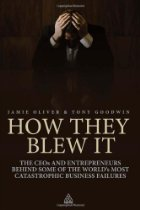
How they blew it by Jamie Oliver and Tony Goodwin

Reach back into your memories of your high school English class and remember hubris, that overwhelming, overblown feeling of pride and self-confidences, that the gods enjoy punishing, usually with maiming, sometimes with thunderbolts. How They Blew It: The CEOs and Entrepreneurs Behind Some of the World's Most Catastrophic Business Failures catalogs some of the most astonishing business failures of the past decade and hubris seems to be the principal cause of many of these failures. That and losing track of what business, exactly, their companies were in.

From entrepreneurs that ran afoul of their former business/government allies (Khodorkovsky, Berezovsky and Zhengyi) to CEOs who were eaten for lunch when the banks tanked (Johannesson, Fuld and Cayne), and including the tragic ends of two CEOs (Merckle and Foster) who took their lives--and the lives of his family, in the case of Foster--when their investments fell apart, How They Blew It is an international rogues' gallery of business leaders whose investments just seemed to implode. One of the conclusions that the book reaches is that the failed business leaders were too smart for their own good and tended to overlook what their delegates were doing or to keep their eye on the business bottom line. As a statement about how to stay focused on the core business, How They Blew It lays out a case for looking to the future while also concentrating on the present.

Though most of the cases are laid out in a lurid, breathless fashion, and most of the sources cited are business periodicals with no references to books written about the events, the book does also remind the reader that entrepreneurs can be very successful, and even if they don't achieve dazzling fortunes, entrepreneurs account for a significant number of jobs and create wealth, even on a small scale. This book would be useful to librarians who are trying to get a handle on some of the biggest business scandals and debacles of the past decade but it would also provide a starry-eyed entrepreneur with a warning about reaching too far with one hand while failing to hold on to a firm base with the other. Which is the point about stories about hubris--confidence based in actual achievement is good, but excessive pride is punished. Thankfully only in stories is it punished with thunderbolts.

Tuesday, September 14, 2010

Gallery of Best Resumes for People Without a Four-Year Degree by David F. Noble

Gallery of Best Resumes: for People Without a Four-Year Degree (Gallery of Best Resumes for People Without a Four-Year Degree)Part of a series of Gallery of...resume and cover letter resume writing advice, Gallery of Best Resumes for People Without a Four-Year Degree is written for people who have extensive industry experience, who have an associate or two-year degree, or who are competing for a position where a four-year degree isn't necessary and they may have some other type of certification. Students who are transitioning from high school to college or if they are looking for an internship will also find useful advice in this book. There are plenty of jobs, as Noble rightly points out, where a four-year degree is not necessary (such as paralegal) and the assumption shouldn't be made that everyone who uses this book is a college drop out. Samples include senior and mid- level administrators, law enforcement and emergency services professionals, real estate and construction professionals to name only a few of the industries represented in this book.

The book also includes unusual examples, such as the sample resume for a two-person team that worked as apartment managers. This is the first of this type of resume that I have ever seen, but I am sure that in this industry there are many "teams" of managers that could advertise their services on the same document.

There is also basic resume formatting and grammar advice for cover letters presented in a simple point-by -point style. The resume writers that submitted resumes are all identified in the back of the book so the reader can check them out for additional information or to engage their resume writing services if they wished.

Friday, August 27, 2010

Rework by Jason Fried and David Heinemeier Hansson

ReworkRework is a business inspiration book by the founders of 37signals. Rework examines some of the basic tenets of entrepreneurship and running a business and the authors give their own suggestions about why some of these tenets don't work or why the assumptions are false. Some of their ideas include starting a business while keeping your day job, starting a business with your own capital and not turning to the bank or outside funders, and committing to your idea, rather than building a company with the expectation that the sale of the company will allow you to retire--and someone else will profit immensely, or dismantle, your idea.

I really enjoyed the essays in the book, since they were short, punchy and not filled with data and numbers. The essays are about what they feel worked for them and their company, and what they think will help entrepreneurs (ahem, starters) in building their own business. The book is also free of jargon and about using common sense and less hierarchy and delegation to get tasks done. It also about trying new things, learning how to revise and not second guessing every possible outcome without even testing a hypothesis or new technique.

I think I will employ some of their ideas. For example, I love their idea about lists where they suggest that long lists and/or prioritization does not help a list get done. They suggest breaking down lists into much smaller digestible parts, such as a list of one hundred into a list of ten--so when you cross off one item on the list, 10% is completed. And you also get the charge out of completing a major portion which encourages you to tackle the rest. I also liked the "hire great writers" since you know that they can think and communicate clearly--though we know great thinking, like great writing, may need more than one draft or some time to reflect. Putting the back office on the front lines is also another extremely good idea since it can decrease miscommunications and help the "management" understand the clients and their concerns.

This is a good book for a person who needs the courage to start or sustain their own sideline work or for a new manager who just wants some ideas about how to run their ship, especially if they believe that less management is better.

Rework

Tuesday, August 24, 2010

Knockout job interview presentations by Rebecca Cornfield

Knockout Job Interview Presentations: How to Present with Confidence, Beat the Competition and Impress Your Way into a Top JobSo, you've been asked to do a presentation as part of your interview, but you have no idea how to prepare. Or you have done some presentations at interviews and think they are the reason why you have not gotten the job offer. Knockout job interview presentations will explain how to prepare for interview presentations, even if the presentation topic isn't presented to you in advance, what employers are looking for in presentations and how to get feedback on your presentation and your delivery.

For librarians that are preparing for an interview that has a presentation component (usually academic library positions), this book will probably help if you have never given a presentation before or if your presentation experience is limited. If you are already a great presenter or instructor, but you are not quite sure why an employer would want you to present at an interview, this book will help you understand how an employer mindset might be different from a student mindset.

This book is also a very quick read, since I was through it within an afternoon, so you could easily include this book as part of your interview "homework".

Friday, August 13, 2010

Careers after the armed forces by Jon Mitchell

Careers After the Armed Forces: How to Decide on the Right Career and Make a Successful TransitionTransitioning from the military to the civilian workforce is a question that some librarians will have to assist their clients with. Careers After the Armed Forces is written specifically for Forces personnel that are considering leaving the Forces or who are in the process of leaving and who need to find work to support themselves and their families. In brisk, short chapters, the book covers making the decision to leave the Forces, selecting a career, writing a resume, interviewing and salary negotiation.

This book does cover some of the unique problems faced by military personnel, such as why leave the Forces during a recession and translating military experience into the civilian workforce, but most of the topics covered will need to be supplemented with a book or additional resources about a specific part of the work search. For example, the section on resumes should probably be read in conjunction with Best Canadian Resumes and the assistance of a counselor or resume review at the very least.

Both the publisher and the author are from the UK, so some of the terminology—“CV”, as opposed to “resume”, and “pay rise” instead of “raise”— and resources do favour Forces leavers from the UK, but the author does make an effort to write for soldiers in developed, English-speaking nations in general. Canadian Forces members will need to look for resources specific to the Canadian civilian labour force, and the one Canadian website reference in the book generated a 404 Page Not Found error.

On the whole, this book would not be enough for any current military member planning a transition from the military, but supplemented with additional resources specific to the person’s current situation, it would be a good book to get the person thinking about career planning and the steps involved in the process.

Careers After the Armed Forces: How to Decide on the Right Career and Make a Successful Transition

Monday, July 26, 2010

Book review: Google Bomb: The Untold Story of the $11.3 M Verdict that Changed the Way We Use the Internet

Google Bomb: The Untold Story of the $11.3M Verdict That Changed the Way We Use the InternetI have been trying to get a copy of this book since I finished Wild West 2.0 because I was interested in the real life "google bombing" enacted against Sue Scheff. Sue Scheff is the founder of PURE, described as a "parenting advocacy association", and she responded via email to a request from a parent who needed to get her children from a facility in a foreign country. Scheff had a brief electronic advising relationship with this person, but when Scheff had to respond negatively to a request for information, the correspondent began a negative campaign against her, conducted online and using the "google bomb".

In a google bombing, the Google search results affiliated with that person or organization's name are hijacked by results that redirect to sites that are not flattering to the person or organization you just searched for. For example, in Scheff's case, a search for her name led to unflattering and sexually explicit comments about her, which drew users away from her own website and made it look as though she was no longer the upright and impartial advocate that she had portrayed. She lost clients. She lost referrals. She lost esteem in her community of counselors and parents. She also lost her privacy when another  legal deposition, which included private information of clients and her own personal information, such as her Social Security Number, was posted to the Internet. It was at this point that she decided to fight back and launch her court case that ultimately led to the enormous civil decision.

Throughout Scheff's recounting of her struggles, the co-author and lawyer John W. Dozier Jr explains some of the legal issues and decisions about online defamation and trademark law. He explains how online smear campaigns are run and uses personal examples from his own law firm to discuss how campaigns can affect businesses. He describes how there are current legal remedies for these issues if a person or organization comes under attack and how the courts can have real teeth when dealing with a person who attempts to google bomb another person or organization.

I found this book to be highly informative, though I wish there was more information about the steps you can take or how to gather evidence of the attack to take to a lawyer, the ISP that hosts the site or the police should you feel that the harassment may become RL violent.

The book is also part of the "cult of amateurs" camp, in the sense that the educated "grown-ups"--journalists, lawyers, business leaders--should be elevated to Internet authorities and regular people should follow the recommendations of the elite. I would have laughed out loud at Dozier's paternalistic assertion, "if you cannot use and understand that technology your kids are using, then don't allow them to use it" if most of the book had not been written in such a calm and authoritative manner, so that this seemed like a reasonable assertion. However, no more chemistry sets and wrenches, junior, because I just don't know a Philips head from a hammer, so you can't play with one either, is not a reasonable assertion.

The harassers that this book described are not the same as everyday people who have expertise in a field. I am also not advocating surgery by non-surgeons, but I think a mechanic can offer better opinions than a marketer on a automaker's blog, and a person who receives customer service can offer a different side to the story of the interaction than the person who gives customer service. It is also rather ridiculous to suggest that all college educated experts are non-biased. Some "citizen journalists" are civil, honest and knowledgeable--and they are not as obsessed and hostile as Scheff's tireless attackers. We can't make the Internet a better place by shutting it down or shutting people out. They will just find another back channel, just as this book describes.


I don't know what the solution is to this dilemma--make people nicer?--but having some knowledge of attacks and how to document them is a good first step.

Google Bomb: The Untold Story of the $11.3M Verdict That Changed the Way We Use the Internet