Showing posts with label business books. Show all posts

Thursday, November 28, 2013

School for Startups, book review

When I first started working in the career centre, and in business librarianship, all small business endeavours that wanted to succeed required a business plan. It was the mandatory task, the one requirement for entrepreneurship. Avoid it at your peril.

Currently, business plans are not required: they are "nice to haves"*--necessary if you are looking for money from a bank or have a class assignment, but no longer the ticket to admission. Now, what is necessary is your idea, a good budget, and a swift move to market. School for Startups: The Breakthrough Course for Guaranteeing Small Business Success in 90 Days or Less, covers these three steps.

School for Startups covers self-employment myths, explains what bootstrapping is and gives the reader encouragement to try some different businesses that might be really, really scary for some people, such as opening an online store or starting an import/export business. Though the book argues that startups can be started for $0, or at least the cost of domain name, some of the businesses mentioned, such as the car export business, cost several thousand dollars to initiate. Again, depending on the type of business the reader wants to found, they will have to supplement their initial reading of this book with more in depth industry research.


If you expect this book to have learning outcomes at the beginning of each chapter with summary questions at the end, School for Startups is not that kind of "course". If I was giving this book to a reader, I would not give it to the reader who has a very strict idea of the type of business they want to operate (I would probably give that person the appropriate volume from Entrepreneur Press' Startup series, or resources from the appropriate professional or industry association), but I would give this book to the person who just doesn't want to work from anyone else, but isn't sure what that involves, except maybe a business loan. This book would also work for the person who wants to try self-employment, perhaps as a summer job or to make their own paid internship, but who isn't sure what they would do, or thinks that they need a grant or business loan to get started.


This book is for:

  • The person thinking about entrepreneurship, but who may not have a specific business idea
  • This is the encouragement book for the reader who has a specific idea, but who thinks that only financing, loans and venture capital will secure their business
  • The reader who is thinking about short term, possibly serial entrepreneurship, creating a business that you can sell to someone else for a profit, which completely matches with the "startup" ethos.

Overall, an enjoyable, quick read, but it does not supplant in depth research.

*Yes, you can disagree with me about the need for business plans.

Tuesday, October 22, 2013

Kickstarter Handbook: Real-Life Crowdfuding Success Stories

Have you thought about running a crowdfunding campaign, specifically on Kickstarter, and wanted to come up with a plan, or at least get an introduction to the platform? The Kickstarter Handbook should be one of the books that you pick up for your research, especially if you have not contributed to a campaign or have only a vague Veronica Mars or Double Fine Adventure vision of how the site works and how much money an entrepreneur can raise on the site.

This book provides a good overview by looking at the platform itself, the types of projects that are eligible for Kickstarter funding and by interviewing actual fundseekers. The author looks at what methods have succeeded and failed. Readers should keep in mind that there is no process or recipe for Kickstarter success and that a project can be snatched from the jaws of defeat with a concentrated final effort--or can fail despite the creator's best efforts and reputation. I also liked the simple worksheets that compared projects and their funding needs based on reward tiers and the actual cost of using Amazon payments and the platform to secure funds. I'm sure that quite a few people who plan to use crowdfunding have confused Kickstarter with an ATM, forgetting that they actually need to deliver--including writing all those emails and mailing labels, not to mention paying the shipping--on all of the rewards they have promised. Don't skip that chapter. I would have liked a chapter on what has happened to people who Kickstarted and didn't deliver, but this is a book about success stories, after all.

The Kickstarter Handbook is a quick read to introduce an entrepreneur to the platform and how it might work for their project. It is not industry or product-type specific, so the reader will have to do additional research into how a designer or a musician can use Kickstarter effectively. The author is a journalist, so it has that Business Insider/Forbes-style of writing, which does make it a  breeze to read; however, it is only the beginning for determining if crowdfunding is the right way to proceed for your project. It may also have insights for the reader who has tried crowdfunding and failed, as well as for the reader who just wants to understand what Kickstarter is and the role it may play in small business finance.

Friday, March 8, 2013

Privacy Law in 60 Seconds Promo Video from the Authors

As a promo for his new book, with co-author Paul Schwartz, Daniel Soslove has put together a 60 second debrief on the main issues around privacy law--and to encourage you to read the book to get the full story.


I really learned a lot from The Future of Reputation, so I am looking forward to this book--in a sort of, wow, homework kind of way.

Friday, May 27, 2011

Thursday, May 26, 2011

Salary Tutor by Jim Hopkinson

This book is forthcoming and will be available for purchase in August 2011. I would like to give a thanks to Netgalley and Grand Central Publishing for making this galley available.

Salary Tutor: Learn the Salary Negotiation Secrets No One Ever Taught You

Learning how to negotiate—for anything, not just salary—is a vital skill, and you will have to use your persuasion and negotiation skills many times in your career.* Negotiating a salary, even your very first salary, is possible and the Salary Tutor explains how to do it in simple, clear, encouraging language. Heck, the author even throws in a flowchart.

I thought the real strength of this book was the preparation of the Industry Research of Salaries (IRS) document, which includes the lowest salary you would accept, the industry standard and the top of the range for the position. The author also includes sources for research (PayScale.com, Glassdoor, Salary.com), though I would also include some of the salary tools from vertical search engines and industry specific salary surveys, if you have access to them, to your research. The author recommends including this document in your portfolio, so it is prepared for interviewers should the issue come up, and to make several different versions of this document. There is nothing like research and preparation for defending your position in a negotiation, so this is not a step to be skipped. Even if you are never allowed to negotiate your salary—which can happen in a union, non-profit or government work environment—it cannot hurt to know if you are making what the position deserves, especially if additional duties are added to your position at a later date.

The author also has some solid advice for freelancers and creative professionals who need to negotiate each and every contract or service for a client, which is not found in many salary negotiation books. So the structure of the book follows: author’s salary memoir, how to negotiate for the first time, negotiating a raise or promotion and negotiating for freelancers. Considering how short the book was, meaning it could be read in an evening, I was impressed with how comprehensive the book was overall.

Since negotiation is important part of career management, I would strongly recommend this book as a simple primer on negotiation. There will be other resources that can supplement the information in this book, but I think it is one of the best introductions to this process that I have ever encountered.

*For librarians, the first time you have to negotiate a discount or a license, you will wish you had spent some time learning how to persuade salespeople to take less from your budget.

Thursday, December 2, 2010

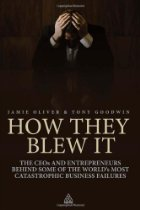
How they blew it by Jamie Oliver and Tony Goodwin

Reach back into your memories of your high school English class and remember hubris, that overwhelming, overblown feeling of pride and self-confidences, that the gods enjoy punishing, usually with maiming, sometimes with thunderbolts. How They Blew It: The CEOs and Entrepreneurs Behind Some of the World's Most Catastrophic Business Failures catalogs some of the most astonishing business failures of the past decade and hubris seems to be the principal cause of many of these failures. That and losing track of what business, exactly, their companies were in.

From entrepreneurs that ran afoul of their former business/government allies (Khodorkovsky, Berezovsky and Zhengyi) to CEOs who were eaten for lunch when the banks tanked (Johannesson, Fuld and Cayne), and including the tragic ends of two CEOs (Merckle and Foster) who took their lives--and the lives of his family, in the case of Foster--when their investments fell apart, How They Blew It is an international rogues' gallery of business leaders whose investments just seemed to implode. One of the conclusions that the book reaches is that the failed business leaders were too smart for their own good and tended to overlook what their delegates were doing or to keep their eye on the business bottom line. As a statement about how to stay focused on the core business, How They Blew It lays out a case for looking to the future while also concentrating on the present.

Though most of the cases are laid out in a lurid, breathless fashion, and most of the sources cited are business periodicals with no references to books written about the events, the book does also remind the reader that entrepreneurs can be very successful, and even if they don't achieve dazzling fortunes, entrepreneurs account for a significant number of jobs and create wealth, even on a small scale. This book would be useful to librarians who are trying to get a handle on some of the biggest business scandals and debacles of the past decade but it would also provide a starry-eyed entrepreneur with a warning about reaching too far with one hand while failing to hold on to a firm base with the other. Which is the point about stories about hubris--confidence based in actual achievement is good, but excessive pride is punished. Thankfully only in stories is it punished with thunderbolts.

Thursday, November 25, 2010

strategy + business Best Business Books 2010

strategy + business have released their list of the Best Business Books of 2010. The list is arranged categorically and includes an essay analysis of the different books, with suggestions of which books complement one another. I recommend downloading the pdf file, which includes all of the essays and the recommended books.

You will need to create a free profile to access the article.

Originally spotted on the 800ceoread blog.

Monday, November 22, 2010

Bloomberg's Top Business Book Picks

Bloomberg's Business Week has published a list of their top business books for the past year. 800 CEO Read places them into a subject list.