Showing posts with label negotiation. Show all posts
Showing posts with label negotiation. Show all posts
Wednesday, November 21, 2012
Maybe it's time to ask for a raise
...Provided that your boss actually reads Evil HR Lady. She summarized a report from the Center for American Progress that suggest that "the average cost of replacing an employee amounts to fully 20 percent of the person's annual salary". So to save 20% of your entire salary, maybe it would be worth it to give you a boost between 2-5%.

Friday, May 18, 2012
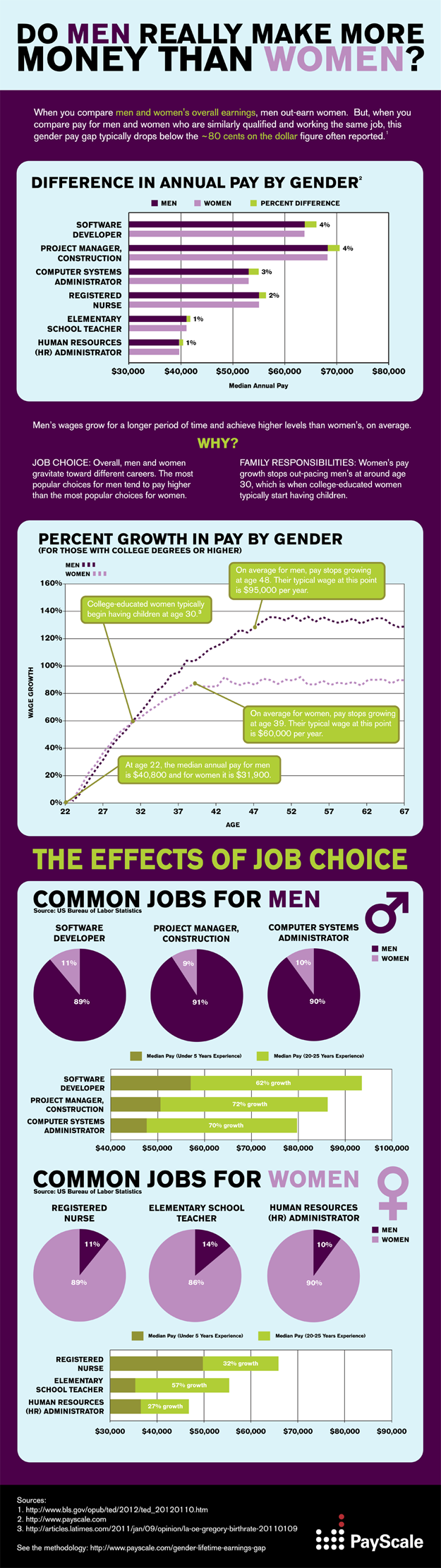
Do Men Really Earn More than Women? Infographic from Payscale.com
If these arguments are correct, women should be reading Women Don't Ask before their salary negotiations.
Thursday, May 26, 2011
Salary Tutor by Jim Hopkinson
This book is forthcoming and will be available for purchase in August 2011. I would like to give a thanks to Netgalley and Grand Central Publishing for making this galley available.


Learning how to negotiate—for anything, not just salary—is a vital skill, and you will have to use your persuasion and negotiation skills many times in your career.* Negotiating a salary, even your very first salary, is possible and the Salary Tutor explains how to do it in simple, clear, encouraging language. Heck, the author even throws in a flowchart.
I thought the real strength of this book was the preparation of the Industry Research of Salaries (IRS) document, which includes the lowest salary you would accept, the industry standard and the top of the range for the position. The author also includes sources for research (PayScale.com, Glassdoor, Salary.com), though I would also include some of the salary tools from vertical search engines and industry specific salary surveys, if you have access to them, to your research. The author recommends including this document in your portfolio, so it is prepared for interviewers should the issue come up, and to make several different versions of this document. There is nothing like research and preparation for defending your position in a negotiation, so this is not a step to be skipped. Even if you are never allowed to negotiate your salary—which can happen in a union, non-profit or government work environment—it cannot hurt to know if you are making what the position deserves, especially if additional duties are added to your position at a later date.
The author also has some solid advice for freelancers and creative professionals who need to negotiate each and every contract or service for a client, which is not found in many salary negotiation books. So the structure of the book follows: author’s salary memoir, how to negotiate for the first time, negotiating a raise or promotion and negotiating for freelancers. Considering how short the book was, meaning it could be read in an evening, I was impressed with how comprehensive the book was overall.
Since negotiation is important part of career management, I would strongly recommend this book as a simple primer on negotiation. There will be other resources that can supplement the information in this book, but I think it is one of the best introductions to this process that I have ever encountered.
*For librarians, the first time you have to negotiate a discount or a license, you will wish you had spent some time learning how to persuade salespeople to take less from your budget.
Learning how to negotiate—for anything, not just salary—is a vital skill, and you will have to use your persuasion and negotiation skills many times in your career.* Negotiating a salary, even your very first salary, is possible and the Salary Tutor explains how to do it in simple, clear, encouraging language. Heck, the author even throws in a flowchart.
I thought the real strength of this book was the preparation of the Industry Research of Salaries (IRS) document, which includes the lowest salary you would accept, the industry standard and the top of the range for the position. The author also includes sources for research (PayScale.com, Glassdoor, Salary.com), though I would also include some of the salary tools from vertical search engines and industry specific salary surveys, if you have access to them, to your research. The author recommends including this document in your portfolio, so it is prepared for interviewers should the issue come up, and to make several different versions of this document. There is nothing like research and preparation for defending your position in a negotiation, so this is not a step to be skipped. Even if you are never allowed to negotiate your salary—which can happen in a union, non-profit or government work environment—it cannot hurt to know if you are making what the position deserves, especially if additional duties are added to your position at a later date.
The author also has some solid advice for freelancers and creative professionals who need to negotiate each and every contract or service for a client, which is not found in many salary negotiation books. So the structure of the book follows: author’s salary memoir, how to negotiate for the first time, negotiating a raise or promotion and negotiating for freelancers. Considering how short the book was, meaning it could be read in an evening, I was impressed with how comprehensive the book was overall.
Since negotiation is important part of career management, I would strongly recommend this book as a simple primer on negotiation. There will be other resources that can supplement the information in this book, but I think it is one of the best introductions to this process that I have ever encountered.
*For librarians, the first time you have to negotiate a discount or a license, you will wish you had spent some time learning how to persuade salespeople to take less from your budget.
Wednesday, January 21, 2009
Don't wait for a rescue
There are lots of posts (like this one) and articles (like this one) about is it a recession or a depression, how long will it last, etc. The only uniform answer is, we don't know. No matter how much knowledge a person has, or expertise in the area, that is the one certainty: we have none.
But there is one constant theme in all of this analysis that is beginning to make me nuts: The Obama Effect (Let Me Google That For You). Obama supposedly has had an effect on the campaign, on the confrontation in Gaza, and now, he will have an effect on the economy, (etc.)--possibly for the better. And his and the plans of his advisors will have an effect on the individual, so the Obama Effect is not all hot air.
But, in case you're confused, Obama's dad was from Kenya, not Krypton. The only person who will save you is you. If you're in school and you're worried about the future, this is what you need to do:
But there is one constant theme in all of this analysis that is beginning to make me nuts: The Obama Effect (Let Me Google That For You). Obama supposedly has had an effect on the campaign, on the confrontation in Gaza, and now, he will have an effect on the economy, (etc.)--possibly for the better. And his and the plans of his advisors will have an effect on the individual, so the Obama Effect is not all hot air.
But, in case you're confused, Obama's dad was from Kenya, not Krypton. The only person who will save you is you. If you're in school and you're worried about the future, this is what you need to do:
- Check your bank balances and start saving, especially if you have no savings. Try this rule: with the exception of cost of living needs, if a desired item costs more than you make in an hour, don't buy it, eat it, visit it, view it, or hang it on your wall.
- Don't buy anything else on credit since you will just have to pay it off later, with interest. Put your credit card in the freezer until you need it to buy bus or plane tickets to interviews or conferences. See suggestions #13 and #15 on ways to save money on traveling.
- Look for ways to bring down your personal costs.
- If you have a student loan, some lenders make sure you go through a consultation about repayment. Find out about getting one booked and learn about the repayment process, especially if your lender has a program for loan remission.
- Ruthlessly squeeze every cent out of your tax return. See if there is a student service that will help you file for free or cheap.
- Is your resume ready to go? If not, complete it and have it proofread by the end of this month.
- What are the job resources available to you in your state or province? Does your library school have a job search library? Have you made job searching part of your daily schedule?
- Ask your current employer about the prospects for extending your job into the summer or the likelihood of a position after you graduate. Do not believe gossip--cut backs or increases--go directly to the person who has hiring authority. Find out about their hiring plans and find out how you can become a candidate.
- Subscribe to the appropriate listservs that have job postings in the field you are interested in.
- Have you spoken with your references, or your internship/co-op coordinator or supervisor? Did you remind them that you are on the market and would be grateful for any advice (read job leads) that they could send you?
- If you are thinking about relocating, start using vertical search engines and niche job boards in that province or state and start applying for work.
- Next month have a mock interview with a real professional interviewer and polish your skills. Get honest feedback, not from a person who loves you or forgot to give you a Valentine.
- Does your web cam work? Do you know how to get it to work if it works but you have never used it? You can keep down interviewing and traveling costs by checking to see if your web cam is ready for action. [Sheesh, not that kind of action.]
- Attend a session on negotiation so you can learn how to deal with HR, interviewers, bankers and landlords, so you can negotiate in regards to rent, repayment and salaries. You will need these skills if you have to work in purchasing or licensing in any library that has contracts with external companies (like, all of them) so now is the time to learn and practice, practice, practice.
- Take advantage of as many free or low cost services that you can use right now, as a student. First of all, take advantage of the student rate to go to library conferences that have a career fair so you can hit at least ten potential employers, and get through some screening interviews.
Thursday, February 7, 2008
My 2%

Does it really make a difference to negotiate your starting salary? Yes, it can since your raises can be calculated by the percentage of salary that you are currently making. Let's look at the example below where Candidate A accepted the minimum and Candidate B negotiated two steps higher for her initial salary.

(These numbers are from the Librarian Salary Scale at the University of Alberta)
You're looking at this table and thinking: really, there is only $1,849 between the two salaries. And I thought I was bad at math. You need to look at the difference over time: over five years, Candidate B makes $8,896 more than Candidate A. It also takes Candidate A two years to surpass Candidate B's initial salary.
Now, there are some assumptions built into this table that you need to know about that also affect the numbers on this table. I did that for a few reasons:
- sometimes steps are for good behaviour, pay tied to performance, and I am positing that there is no difference between the two except initial negotiation. Anyway, Candidate B starts at 2 steps higher than Candidate A, so Candidate B is still ahead and making 2% on a larger gross pay.
- the math was easy, and I rounded. No decimals before coffee.
Subscribe to:
Posts (Atom)