I am a librarian who works in a post-secondary career center. I want to share some of the work search and business resources that I have found useful in my work. I also manage the Facebook group of the same name for library job seekers.
This video has been making the rounds on social media this past week, so if you have already seen it, you can skip it--though it made me laugh every time.
This also explains why some companies try to keep their salary data completely secret. I am sure the monkey's reaction would have been different if she/he had no idea she/he was being cheated out of a lovely grape.
...Provided that your boss actually reads Evil HR Lady. She summarized a report from the Center for American Progress that suggest that "the average cost of replacing an employee amounts to fully 20 percent of the person's annual salary". So to save 20% of your entire salary, maybe it would be worth it to give you a boost between 2-5%.
PayScale.com offered their first Google Hangout on the Value of Education, aka is it worth it to go to college?
The discussion was wide ranging and had a good mix of speakers--a marketer, an economist and a school counsellor--though the moderator could have done a bit more to distribute time amongst all of the panelists.
A story from NPR about a high achieving student choosing the trades over college seems to echo some of the arguments made by the speakers, while also addressing the only the remedial student enters the trades argument. It's a shame that we are still dealing with that stereotype, but this weird belief that only the stupid, usually male, students become tradespeople just won't die in the minds of some parents--and kids.
One area they didn't touch on was when you needed a degree, or a graduate degree, to do the job that you want. For example, if your local authority only hires teachers with a graduate degree to teach in the K-12 schools, you can go to school for a year to be a Teaching Assistant--but that is not a Teacher. And without the four year degree you can never progress into higher level administration or even into instructional or curricular design. In some cases college is the only way to get into a profession, so suggesting that they just pursue the "lite" version of the career is also a waste of their time and money.
However, their point about taking the associate degree, getting some work experience and pursuing additional education with the assistance of their employer is one we try to impress on our students all the time.
There are also some cases where a trade and a degree can go hand in hand. For example, a person who pursues a degree in history but who also works as a carpenter--whether as a full-time worker and a part-time student, or vice versa--may be able to use their trade to leverage their degreed career. As a carpenter and a historian, they could work in a museum (or form their own company) to build and repair exhibits; they can work in historical interpretation as a carpenter; they can also use their skills and knowledge to preserve historic homes or buildings. I wish sometimes that people would consider how a trade and a college degree can enhance one another, rather than the liberal arts depriving our economy of a plumber. (In fact, a chemistry class would have helped the plumber who told me that I could boil lead out of my water--but I consider him to be unusual and not the norm.)
They are also trying to continue the conversation on Twitter with the hashtag #valueofed, but they couldn't have anticipated the Twitter shutdown during their hangout.
Points to PayScale.com for using Google Hangouts. I'm looking forward to more of these.
This one comes from BUST stating that Batgirl was/is a feminist. Since she is like a patron comic saint to many librarians, this is a cool plea for equal pay for equal crimefighting.
If these arguments are correct, women should be reading Women Don't Ask before their salary negotiations.
Friday, January 20, 2012
PayScale has released National Pay Trends Index which shows that wages were improving in 2011. You can also add a comparison to the national trend by metro area, by company size or by industry.
This book is forthcoming and will be available for purchase in August 2011. I would like to give a thanks to Netgalley and Grand Central Publishing for making this galley available.
Learning how to negotiate—for anything, not just salary—is a vital skill, and you will have to use your persuasion and negotiation skills many times in your career.* Negotiating a salary, even your very first salary, is possible and the Salary Tutor explains how to do it in simple, clear, encouraging language. Heck, the author even throws in a flowchart.
I thought the real strength of this book was the preparation of the Industry Research of Salaries (IRS) document, which includes the lowest salary you would accept, the industry standard and the top of the range for the position. The author also includes sources for research (PayScale.com, Glassdoor, Salary.com), though I would also include some of the salary tools from vertical search engines and industry specific salary surveys, if you have access to them, to your research. The author recommends including this document in your portfolio, so it is prepared for interviewers should the issue come up, and to make several different versions of this document. There is nothing like research and preparation for defending your position in a negotiation, so this is not a step to be skipped. Even if you are never allowed to negotiate your salary—which can happen in a union, non-profit or government work environment—it cannot hurt to know if you are making what the position deserves, especially if additional duties are added to your position at a later date.
The author also has some solid advice for freelancers and creative professionals who need to negotiate each and every contract or service for a client, which is not found in many salary negotiation books. So the structure of the book follows: author’s salary memoir, how to negotiate for the first time, negotiating a raise or promotion and negotiating for freelancers. Considering how short the book was, meaning it could be read in an evening, I was impressed with how comprehensive the book was overall.
Since negotiation is important part of career management, I would strongly recommend this book as a simple primer on negotiation. There will be other resources that can supplement the information in this book, but I think it is one of the best introductions to this process that I have ever encountered.
*For librarians, the first time you have to negotiate a discount or a license, you will wish you had spent some time learning how to persuade salespeople to take less from your budget.
According to a study from the University of Chicago, women are less likely to apply for positions where the pay structure involves a competition with other employees--unless local wages were less than what the position offered as a base rate.
This article from the Evil HR Lady made me think about how many new librarians who may find themselves in this position: they were hired to replace a retiring librarian who had been with the system for a long time. Like an experienced chef, he/she kept all of their recipes in their head and has now departed with them--but the patrons still like the cooking.
Sadly they may not feel like they are doing a good job, when there is nothing they can do about the nostalgia that the patrons had for the old librarian. This is not a feeling that you can fix--you can only make new memories. I hope they are better ones, but some will suck and possibly hurt your feelings.
Lucas' advice for getting a raise based on over work seems sound, but it is going to take some gumption to go into the supervisor's office and ask for additional training for something that you were hired to do--and what you feel you need more training for. If this is the case, be sure to ask for something that develops your duties--you learned about general collection development and now you need funds to go to a conference that is specific for YA materials. Maybe you need more training in developing reading skills or reaching newcomer patrons. But make sure you ask for training in something that is step two in the process and not the stuff you should have known.
It is also incorrect to value your salary as the same a person who just departed after 20 years--most people will get raises based on duration of service, if only to keep that person in the position. And it sounds like she worked hard for the money and they needed to keep her. You are not yet entitled to the money to entice a long-term, knowledgeable employee to stay. You are entitled to more pay if you need to assume more duties than you were originally hired to perform.
To use it, you need to indicate the region where you are looking for work, the type of work you are looking for, the education that you possess and the amount of experience you have in the field. The calculator reports the amount of compensation you can expect to receive. If available, it also tells you how many salaries it used to come up with this figure.
For example, I tried Librarian in Flagstaff, Arizona and gave the minimum requirements of required degree and less than one year of experience. The response told me how many librarians were employed in the region (80), provided the starting salary $23,370 and suggested that a librarian with this level of experience was most likely to be offered a salary of $28,200. The calculator also reported that the salary information does not include any other compensation information, such as benefits.
This is a useful tool not only for recent graduates and current librarians but for our clients that are researching salary information to plan a move or to include this information on a cover letter.
ACRL and CUPA-HR have updated the librarian job descriptions within an academic library. What is this good for? Well, it helps with the designation of job duties, the assessment of salaries (so it can help you with negotiation) and can give you an idea of a career path/course within academia. At your home institution, your home team HR will probably use it in job needs assessment and to consult if your position is reclassified, or if you are in a new position and they aren't sure how to describe your work.
There is some attached salary information, but without looking at the results, I can't tell you how many libraries responded with salary data (and it isn't all the ACRL members) and you would also have to adjust that data for college size and geographic location, so supplement it with some research into the collective agreement of the institution and the salary survey of the local professional library association.
Statistics Canada released a study today about the earnings of women who have and don't have children (the release on the Daily, the full text of the study is available on Perspectives on Labour and Income).
From the summary of the study:
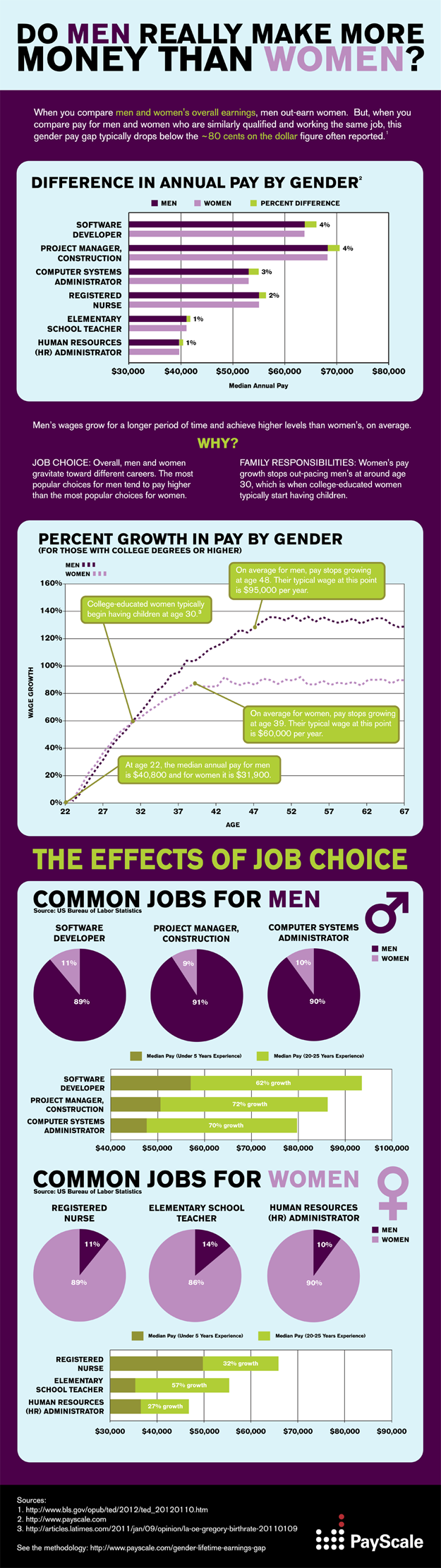
On average, the earnings of women with children were 12% less than those of women without children, and this gap increased with the number of children: with one child, the gap was 9%; with two children, it was 12%; and with three of more children, 20%.
The study also looked at the differences between single mothers, singletons without sprouts, and partnered women with children. And yes, it was worse to be a single mother:
A comparison between single mothers and childless single women showed that the average earnings gap was close to 20%. But for married/common-law mothers versus childless women in couples, the gaps was only about 10%.
Other interesting findings from the study included that the less time off with children (a gap) could positively influence earnings, as well as delaying a family.
Since so many librarians are women, I thought the study would be interesting; maybe we should just be interested in the results since so many of us know women.
WowJobs is a vertical search engine for the Canadian marketplace. It has already done cool stuff like search for results in Craigslist, but now, based on the information in the job postings that it skims, the search engine can provide a salary search.
As shown above, you can also compare salaries between types of jobs or by location. I went Canada-wide to get an idea of the basic salaries, but you can--and should, if you are asked to provide a quote--search geographic-specific.
Where do they get the numbers? From job postings that supply salary information. It is not clear, when a range is used, if they use the bottom of the range or the top of the range to create their calculation. Not every job provides salary information, so it isn't taking data from all of the postings that the engine has scraped. To ameliorate this issue, WowJobs is supplying a confidence level: how sure are they that the numbers are accurate? and including this with the results that you receive for your search.
This service is currently in beta, so we can expect more improvements as they get more sophisticated with the enormous amount of raw data supplied in a posting. Maybe they'll run a map mash-up that will let us see where particular jobs are concentrated, based on their historical data? For example, more postings in Toronto in June or October?
You can use this search engine to supplement the salary information that you find from other professional library sources.
This 60 Second Science podcast refers to a study that suggests that men who hold more traditional beliefs about male and female roles make more money. Since the snippet doesn't reveal what industry these men worked in, or what city they worked in--which also affects how much cash they make--you can guess that some of them are supporting Real Housewives.
But the women who were surveyed who tend to hold more traditional views, make $1,500 less than women with less traditional beliefs--again, without stating were they lived, worked and did their nails.
However, it does reinforce my belief that if you don't know how much you are worth, you don't know how much to ask for.
I know, I know, this has nothing to do with how much naughty vs nice librarians make, but when I got Mean Librarian Salaries up to 2% in 2008, in my mailbox I had to laugh. Don't be nice: you'll get better pay for nasty. Something I have long suspected.
You can also get the ACRL salary survey data for free, and remember to check with SLA for their (not free) data. I think this data should be free to independent members so they can negotiate their salaries with better, more trustworthy data, but the last time I suggested this at a presentation, a member of the audience piped, but we can get it at the library. It is, at least, reliable data, and you might want to consult the tables prior to an interview.
This is why we can't get salary information: money talk is taboo. If people won't provide information about salary--and getting ranges makes people touchy enough--it is almost impossible to get accurate salary data for surveys.
Many salary survey sites are getting around the talking with people problem by using the salary information posted in job ads. However, this is merely a range, and they don't know what number the person was offered and what she accepted for the position.
Compound this with most people don't know how much money they make, just that they have some, and you can understand why salary data is unreliable.