Showing posts with label career books. Show all posts

Friday, May 16, 2014

What Color is Your Parachute? Guide to Rethinking Resumes - Review

Occasionally, Richard (Dick) N. Bolles will release a sort of special focus guide, such as his books on online job search, that are complimentary to the annual What Color is Your Parachute? Like the other Parachute books, Rethinking Resumes is written in the same clear, plain-language style, updated to reflect the times and concerns of his regular readers and any job seeker. The virtue of this series has always been its clarity, the common sense and pragmatism, and Bolles willingness to update and credit other career and HR professionals for their ideas, which this book also possesses.You can read Rethinking Resumes in an evening, and probably go back in a few months and find something new that you glossed over, and both readings will be worthwhile.

However, there will be a few readers who will pick this book up and wonder A resume book with only one sample? Get over it. Even in resume books with one hundred samples, job seekers still struggle with what to do in their individual case and this book will help answer those questions. The 45 Question Starter Kit (pp. 55-63) is something that I will go over with clients when they have questions about how to write a proper Highlights section.

In addition, there is also plenty of good advice on deciding if you want to hire a resume writer or write your own resume, how to find out if a resume service is a scam, what type of resume to post to a job board and the targetting required to give a resume directly to an employer.

I'm grateful for the section on removing empty keywords and phrases on resumes, as well as the list of stinkers provided, and the process Bolles provides for developing better statements about work experience (pp. 45-47), though I think many job postings are still referring to these phrases as key components while the recruiters who screen the resumes in response those postings are distastefully holding their noses while working through the empty text.

Each year we assign reading to our incoming student staff, and I wish I had got my copy of this earlier so I could add it to our reading list. I think they would have gotten a great deal out of it, and I'm glad it will be available to them in this year. Personally, I would put this next to Why Good People Can't Get Jobs: The Skills Gap and What Companies Can Do About It on my mental bookshelf to recommend to people who are trying to put together a resume that will get them an interview.

Thursday, April 18, 2013

This is How You Get Your Next Job by Andrea Kay

This is How You Get Your Next Job is about "fit" and how to manage the employer's impressions, or "negative impressions", of your suitability for employment. It is not targeted at any one industry or type of worker, such as professionals or entry-level workers, and though many job seekers will take something of value away from the book, any potential reader who has been told that they didn't get the job offer because of "fit" or for the person about to go for their first skilled-occupation interview.

Overall, the author has offers advice and exercises that will help with interview preparation, such as the list on What employers look for that includes desired qualities such as flexibility, stable behavior and intellectual curiosity, and the Would You Hire You test which includes several essay type questions that will include content you can use for answering interview questions. The encouragement for reflective thinking and self-examination, especially for a person that has had a few failed interview attempts and needs to examine their behavior in the interview, would be helpful for some readers. I would pair this one with Ron Fry's 101 Great Answers to the Toughest Interview Questions, which I like for basic training in interviews.

The author does spend a lot of time focused on the "negative filtering" techniques that employers use to decide who is a suitable candidate. Negative filtering is a cognitive trick used to determine if something is mismatched or incorrect according to our perceptions. In a mild form, negative filtering could mean removing a candidate from the running because they fail to show up wearing a tie. In its most abhorrent manifestation, when a candidate is the wrong religion, race or gender for a job, negative filtering can remove those candidates from consideration, based on the filter of the interviewer. Most of the book focuses on the failure to demonstrate follow through or stable behavior and how those traits are demonstrable and when not achieved how an interviewer can filter candidates out based on the lack of those traits. On the whole, when considering the exercises, candidates can make sure that they demonstrate the traits that employers look for and apply it to their career management.

I did like this book, especially for a reader who is getting ready to enter the professional work force, though I felt demoralized by the litany of employer complaints that sometimes felt frivolous. For example, one interviewer states they would not hire a person who wore patterned hose. Maybe the person meant the airy crocheted kind or fishnets, but this seems to be pretty picky when compared to a person's ability to regularly show up on time and write cogent sentences--not to mention the fact that the patterned salesperson could sell snow to an Inuit. Some of the employer likes and dislikes seemed a little silly when the person's abilities were not considered, but the candidates were discarded for trifling fashion faux pas or some conservative bulwark against tattoos or piercings.

The advice on what to say and not say in an interview, your first presentation to an employer, was really well done, even if some of the picky faults were a bit exasperating at times. I would recommend readers who have the presentation down pat to review the chapter on Things you should never do once you get a job or in your career--ever as a worthwhile introduction to basic career management and etiquette when dealing with colleagues and supervisors. This is How You Get Your Next Job is useful, though it can get a little annoying at times, but it does remind you that interviewers are human too, with their own foibles that candidates need to acknowledge to find employment.

Friday, May 20, 2011

Job-Hunter's Survival Guide by Richard N Bolles

The Job-Hunter's Survival Guide: How to Find a Rewarding Job Even When "There Are No Jobs"Richard N. Bolles has produced a Coles Notes version of his famous What Color is Your Parachute? which could be read in an evening and provide the pertinent points from his more well-known work. This booklet includes the well-known "Flower Petal" exercise, as well as some of his basic charts for self-assessment and a discussion of the most effective methods for job search. Not included in this book is his explanation of information interviewing and how to do it.

Though I firmly agree with Bolles that a job search is more effective if the search is targeted and that multiple job search methods are essential to successfully finding a job, I have to disagree with his #4 most successful method for finding a job: going door to door. Now, this will work if you are looking for the kind of employment that does not include a heavily guarded HR office (and any library or academic institution I can think of has at least one HR person), this method will work. It will probably land you a survival job--and if you need one, try this method. However, using his most effective job search method--complete an inventory and know what you are looking for--will lead to a professional job, so it seems petty to quibble with one method. 

Bolles wrote this book to be a short version of What Color is Your Parachute, suited for the recession, for people who need to find a job NOW, and who don't have a lot of time, or money, to spend reading career books for advice. On those grounds, this book is successful and would be useful for a job seeker who needs to make a plan and get job hunting.

Wednesday, May 4, 2011

Career Opportunities in Library and Information Science by Allan Taylor and James Robert Parish

Career Opportunities in Library and Information ScienceCareer Opportunities in Library and Information Science is part of a series of Career Opportunities in...books from Checkmark Books. Like all of the books in the series, the main portion of the book is devoted to occupational profiles which includes a list of duties, salary expectations, a position description and education requirements. The relevant associations and unions are also listed for each of the profiles, and the websites for these organizations are a good source for job postings as well as professional development opportunities. The book is divided into four sections: Librarians and information professionals, then the technicians and assistants found in each field.
Each of the profiles also include a "career ladder" which shows the entry-level positions associated with the career profile and then the career progression, such as the Public Services librarian, who may enter the profession as a library technician or a library assistant, then progress to Public Service Librarian and possibly achieve a senior level position in this area as a Chief Information Officer, a Library Department Head or Library Director.


This book would, of course, be useful to a person who is research library science as a career and who is thinking about applying to a library science program, but it would also be useful to a graduate who is deciding what types of positions to apply for, how to prepare for an interview, or for a mid-career professional who is thinking about a transition from their current sector to another position, though they may wish to stay in libraries or information management.

Monday, August 16, 2010

Tuesday, May 12, 2009

Museum Careers: A Practical Guide for Students and Novices

Museum Careers: A Practical Guide for Students and Novices by N. Elizabeth Schlatter takes a look at the wide variety of careers available in the museum sector. (As an aside, when you call something a sector, it is a subdivision within an industry. Sectors are kinda like small cities in that they need a wide range of careers--in the case of museums, marketers, educators, consultants, curators, and, yes, librarians, to power them). Museum Careers provides an history and overview of the museum sector, describing the types of museums and then the types of occupations found within museums.

There are careers in museums for librarians, though librarian as a specific career only gets about two pages in this book. But there are several other careers to explore--especially for someone with a PHd who wants to escape from academia but still live a mindly life--and this book does provide summaries of many of the most visible, along with signposts to where these jobs are usually advertised.

The good news: "There's no one direct route to a museum job" (p. 10), though the bad news is, so many people want to work in museums that the competition is stiff and this can keep wages low.

The book doesn't have much (anything) on sample resumes or possible interview questions, but it is so strong on providing a background on the museum sector that I am going to recommend this one to anyone looking for a job within a museum--or possibly an archive--as requisite background reading to prep for an interview or to do some career exploration.

Wednesday, July 30, 2008

Job-hunting Online

Job-Hunting Online is a member to the best-selling What Color is your Parachute? series--the principal book in this series is released in a new version each year--which is probably one of the most well-known career guidance series. The author, Richard Bolles, has managed to create a career management empire with materials for job seekers, including special audiences such as teenagers and the "disabled", and for career counsellors. This volume focuses on the Internet and its resources for job seekers.

This book is a general job guide, meaning it is suitable for everyone who wants to use the Internet to find work, but that doesn't mean that librarians can't get something out of it. First, the two Bolles are skeptical about the overall effectiveness of a one method, Internet-or-bust, job search strategy and they assess how effective each type of resource is for finding work. Sites that have a cost to use are identified with a dollar sign, but the majority of resources are free. There is good coverage for using major job sites to find work, finding career advice, like getting in touch with a counselor, and using the Internet for networking. Most librarians are going to be fairly technically savvy--they flog us with mouse cords in library school--but if you had to find an Internet guide for an irregular Internet user, this would be the one that I would give them to get started. I also like this one better than the Guide to Online Job Searching--though I haven't looked at this year's edition yet--since the Bolles' book is tied to an actual job seeking strategy that looks at how effective a site is, not just the resources available on the site.

The authors also tie the book's resources to the job seeking strategies outlined in What Color is Your Parachute?--and if you think the Internet is the best place to find a job, march straight over to your library and pick up a copy of Parachute (you need it).

Many of the links, with slightly different categorization, are available on Bolles' portal JobHuntersBible.

Thursday, April 3, 2008

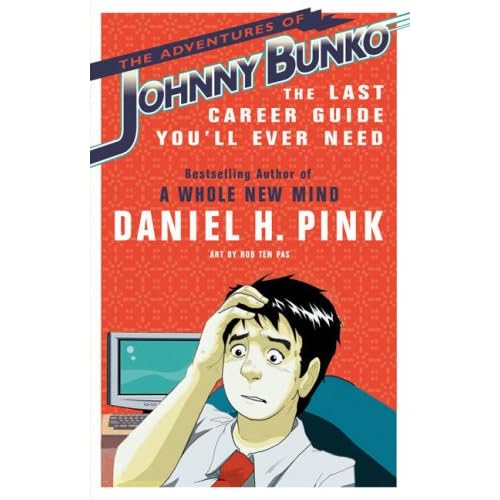
Adventures of Johnny Bunko


Johnny Bunko is stuck in a dead-end job at BOGGS, hopelessly examining spreadsheets for minute errors and doing things that he hates doing...but doing the things that his parents, advisors and career books told him to. One night, slaving late over spreadsheets, Johnny goes to a mysterious sushi house and picks up some chopsticks that, when opened, release his Elfquest style guide, Diane. Diane has a plan and enough mojo to get Johnny where he needs to be to experience her six steps to career fulfillment. If Johnny can pay attention, follow them and not implode at BOGGS.

Described as the "last career guide you'll ever need", I was pretty skeptical since I read quite a few career books. Actually, it is the last career guide that you'll ever need, provided that you follow the book's extra suggestions, and well, actually try to experience the advice. I really liked the 6 steps and I think that many people, especially people in service careers, will really appreciate the last step and it will help them give meaning to their plans. I also loved the manga aside jokes and, as a manga reader, I liked the OEL feel of the book with the Japanese sound effects and references. If you're looking for something to give you some direction and you don't care what colour the parachute is, pick up some chopsticks and visit with Diane and Johnny.

Tuesday, March 18, 2008

How to pick a career book

Because I work in a library with a specialized collection--career advising and counselling, a subsection of business and organizational management--I can tell you a little bit about the career books genre. There are four different types of book in this genre: profiles, samples, advice/coaching and instruction.
  • Profiles: are books that describe a potential career and give a day-in-the-life snapshot, as well as a "how do I get this job" map. Profiles are the most useful if you don't know what a person in specific career path does, such as you want to be a proof reader, but is that as cool as a copy writer? Profile series include books from McGraw Hill, such as the Careers for or the Opportunities in series. The best examples of occupational profile books are in the series Career Opportunities in from Facts on File. You can also look at occupational profiles from NOC (Canada) or ONET (US) , but these are far more general than the industry or sector information found in the print resources. JIST makes a good series on Top Careers based on the data from BLS.
  • Samples: are just that, lists or samples of types of information. Most often you are looking for resume samples, or lists of interview questions, just so you can have some minimal guidance. Samples are most useful if you just need a clue. Many sample books, such as Best Canadian Resumes, will also include some instruction as well as the samples.
  • Advice and coaching: You're a comeback mom who wants to return to work, or you want to be self employed and need some intrepid, peppy heroism, or you are a new grad who keeps falling asleep at your desk at 3 o'clock like an overclocked kindergartener since your employer cruelly makes you stay awake until 5pm. You need an advice or coaching book. Advice and coaching books include information on career management within a holistic, life context. What Color is Your Parachute is an advice or coaching book, and Brazen Careerist is an advice/coaching blog.
  • Instruction: can't network, your public speaking technique is sweating silence or you need to interview like a top MBA? You are looking for an instruction book, a coupling of advice and samples that avoids telling you what to do with your eggs.
If you're a librarian recommending a career book, it isn't enough that career is in the title. Ask: do they need advice or do they need a sample? Some career books have agendas, religious or political, that your reader may not have on his agenda. The popular books are also usually written by middle class white people who know a lot about middle class, college educated whiteness and not a lot about the culture of the person who you are recommending the book to. Some of these writers love being your Aunty Agony (read about the egg thing if you don't believe me). So suggest with caution and ask yourself what you need before you buy: instruction, direction or advice?