Friday, April 8, 2011

Thursday, April 7, 2011
Editorial intern- volunteer position
Name, address and email of editor to submit application is on the journal's website. It has been removed from the posting to avoid spamming the editor.
Evidence Based Library and Information Practice seeks an enthusiastic graduate student from the field of library and information practice who is committed to improving our profession through service and scholarship.
The ideal candidate for the Editorial Intern position will have some knowledge of the publishing field, be proactive, creative, have a good eye for detail, and the ability to meet tight deadlines. This position will suit someone with an interest in evidence based practice and open access.
The Editorial Intern will contribute to the success of Evidence Based Library and Information Practice and gain experience in research publication by assisting the Editorial Team with the following:
This is a voluntary position that will ideally last for 2 years. We anticipate the time commitment to be approximately 10 hours per month.
About the journal
Published quarterly by the University of Alberta, this peer-reviewed, open access journal is targeted at all library and information professionals interested in an evidence based model of practice. By facilitating access to librarianship research via original research articles and evidence summaries of relevant research from the library literature, Evidence Based Library and Information Practice; will enable librarians to practice their profession in an evidence based manner.
Please visit the Evidence Based Library and Information Practice web site for further information about the journal.
Evidence Based Library and Information Practice seeks an enthusiastic graduate student from the field of library and information practice who is committed to improving our profession through service and scholarship.
The ideal candidate for the Editorial Intern position will have some knowledge of the publishing field, be proactive, creative, have a good eye for detail, and the ability to meet tight deadlines. This position will suit someone with an interest in evidence based practice and open access.
The Editorial Intern will contribute to the success of Evidence Based Library and Information Practice and gain experience in research publication by assisting the Editorial Team with the following:
- Promoting / marketing the journal, including calls for volunteers and calls for papers in order to reach a wide and diverse audience
- Examining proofs for consistency and accuracy prior to publication
- Updating metadata in the Open Journal Systems software (OJS)
- Managing administrative information in the OJS
- Contributing ideas for feature issues and ways to improve the journal
- Participating in editorial meetings and discussions
This is a voluntary position that will ideally last for 2 years. We anticipate the time commitment to be approximately 10 hours per month.
About the journal
Published quarterly by the University of Alberta, this peer-reviewed, open access journal is targeted at all library and information professionals interested in an evidence based model of practice. By facilitating access to librarianship research via original research articles and evidence summaries of relevant research from the library literature, Evidence Based Library and Information Practice; will enable librarians to practice their profession in an evidence based manner.
Please visit the Evidence Based Library and Information Practice web site for further information about the journal.
Thursday, March 31, 2011
Knowledge@Wharton High School
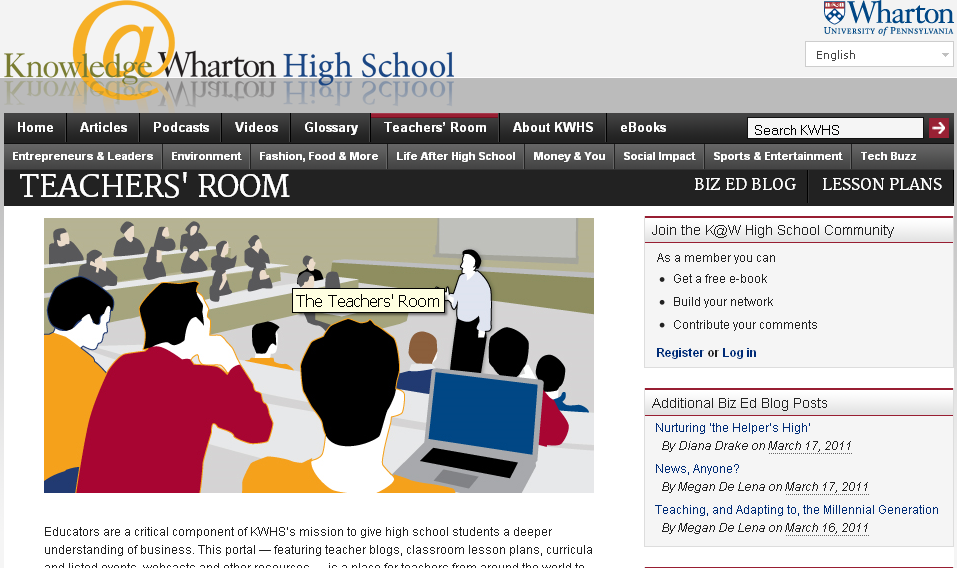
Under its online aegis of Knowledge@Wharton, Wharton Business School has launched a website aimed at high school students to provide them with information and news stories about business. Knowledge@Wharton High School includes news stories about high schoolers engaged in business or competitions, career profiles, videos and ebooks. In addition to the resources for high schoolers, there is a specific section for teachers which includes class plans and invitations to submit both blog posts and lesson plans. Some of the content is also available in Spanish.
Thursday, March 24, 2011
Are the niche boards eating Monster's lunch?
Not likely--would you eat a monster's lunch? Workforce Management* looks at the proliferation of niche job boards and how attractive they are to employers to find qualified or specialized candidates in a specific industry or sector.
Well, I knew there were a lot of job boards, but not that it was anywhere near that high a number.
Monster has opted to go with more accurate search tools for employers, rather than specializing their job boards. If you remember what happened in the contest between the Yahoo! directory and keyword search, perfected by Google, you'll remember how that battle turned out.
*You need a log on and password to access content on Workforce Management; sign up is currently free.
"Today, some 100,000 Internet job boards vie for listings and résumés, double the number in 2000..."
Well, I knew there were a lot of job boards, but not that it was anywhere near that high a number.
Monster has opted to go with more accurate search tools for employers, rather than specializing their job boards. If you remember what happened in the contest between the Yahoo! directory and keyword search, perfected by Google, you'll remember how that battle turned out.
*You need a log on and password to access content on Workforce Management; sign up is currently free.
Wednesday, March 23, 2011
"Follicular restrictions"
BBC News asks, "Should men in uniform be forced to shave?" Since this is an issue, supposedly, of work place safety and an assumption of the work place identity, some argue that men should shave. However, religious and cultural requirements are butting heads with no-beard policies.
In addition, policies are not applied uniformly. Some policies state if the commanding officer says, it's ok, well then it is ok--which, of course, will only last as long as the commanding officer does or for how long the bearded serviceman stays in the unit.
So, shave or don't shave? And who should get the dispensation to keep facial hair?
In addition, policies are not applied uniformly. Some policies state if the commanding officer says, it's ok, well then it is ok--which, of course, will only last as long as the commanding officer does or for how long the bearded serviceman stays in the unit.
So, shave or don't shave? And who should get the dispensation to keep facial hair?
Tuesday, March 22, 2011
Reference and Outreach Archivist
Reference and Outreach Archivist
Manuscripts and Archives department
Sterling Memorial Library
Yale University, New Haven, CT
Rank: Librarian I-III
www.yale.edu/jobs
Fixed Duration: Three (3) years from date of hire, non-renewable
Full-time (37.5 hours per week); Standard Work Week (M-F, 8:30-5:00); occasional evening and weekend hours
Yale University offers exciting opportunities for achievement and growth in New Haven, Connecticut. Conveniently located between Boston and New York, New Haven is the creative capital of Connecticut with cultural resources that include two major art museums, a critically-acclaimed repertory theater, state-of-the-art concert hall, and world-renowned schools of Architecture, Art, Drama, and Music.
THE UNIVERSITY AND THE LIBRARY
The Yale University Library, as one of the world's leading research libraries, collects, organizes, preserves, and provides access to and services for a rich and unique record of human thought and creativity. It fosters intellectual growth and is a highly valued partner in the teaching and research missions of Yale University and scholarly communities worldwide. A distinctive strength is its rich spectrum of resources, including more than 12.5 million volumes and information in all media, ranging from ancient papyri to early printed books to electronic databases. The Library is engaged in numerous digital initiatives designed to provide access to a full array of scholarly information. Housed in the Sterling Memorial Library and twenty school and departmental libraries, it employs a dynamic, diverse, and innovative staff of over 500 who have the opportunity to work with the highest caliber of faculty and students, participate on committees, and are involved in other areas of staff development. For additional information on the Yale University Library, please visit the Library's web site at http://www.library.yale.edu/.
MANUSCRIPTS AND ARCHIVES
Manuscripts and Archives in the Yale University Library is a major center for historical inquiry and also serves as the documentary memory of Yale University. The repository holds 64,000 linear feet of material. Half of the holdings is comprised of more than 1700 collections of personal and family papers and organizational records that document a variety of subject and geographical areas, and half is comprised of the Yale University Archives. The repository also preserves and services 4000 testimonies from the Fortunoff Video Archive for Holocaust Testimonies. Each year the materials are consulted by more than 1000 Yale faculty as well as students and scholars from the United States and throughout the world. The staff of the repository consists of fourteen professionals, two managers, ten support staff, and fifteen student assistants and occasional temporary positions. They are responsible for the selection, acquisition, arrangement, description, and preservation of manuscript and archival collections and for providing reference services for in-person and long-distance research, services to University offices, and teaching assistance in the use of the collections. Please visit us online for additional information at http://www.library.yale.edu/mssa/.
POSITION DESCRIPTION
Reporting to the Head of Public Services, the Reference and Outreach Archivist is responsible for providing reference services to Yale faculty, students, staff, and visiting researchers. Participates in the ongoing outreach program that targets Yale undergraduates. Designs, develops, and implements pilot outreach programs to the Yale community, especially Yale graduate students and new faculty. Recommends appropriate Web technologies to enhance outreach and instruction.
RESPONSIBILITIES
QUALIFICATIONS
Master’s degree from an ALA-accredited program for library and information science. Appointment to the rank of Librarian II requires a minimum of two years of professional experience and demonstrated professional accomplishments appropriate to the rank. Appointment to the rank of Librarian III requires at least five years of professional experience and demonstrated professional accomplishments appropriate to the rank, as well as ongoing engagement in professional development, research, or services. Ph.D. in History or related humanities discipline. Formal archival training or education and/or demonstrated knowledge of archival theory and practice.
Preferred:
Experience providing reference services in an academic research library setting. Experience teaching with primary resources in an academic setting. Graduate-level coursework in American History.
SALARY AND BENEFITS
We invite you to discover the excitement, diversity, rewards and excellence of a career at Yale University. One of the country's great workplaces, Yale University offers exciting opportunities for meaningful accomplishment and true growth. Our benefits package is among the best anywhere, with a wide variety of insurance choices, liberal paid time off, fantastic family and educational benefits, a variety of retirement benefits, extensive recreational facilities, and much more.
Applications consisting of a cover letter, resume, and the names and contact information of three professional references should be sent by creating an account and applying online at www.yale.edu/jobs for immediate consideration - the STARS req ID for this position is 12343BR. Please be sure to reference #12343BR in your cover letter.
BACKGROUND CHECK REQUIREMENTS
All external candidates for employment will be subject to pre-employment background screening for this position, which may include motor vehicle and credit checks based on the position description and job requirements. Internal candidates may be subject to a motor vehicle or credit check for this position based on the position description and job requirements. All offers are contingent on successful completion of the required background check. Please visit www.yale.edu/hronline/careers/screening/faqs.html for additional information on the background check requirements and process.
Yale University is an affirmative action/equal opportunity employer. Yale values diversity in its faculty, staff, and students and strongly encourages applications from women and members of underrepresented minority groups.
Manuscripts and Archives department
Sterling Memorial Library
Yale University, New Haven, CT
Rank: Librarian I-III
www.yale.edu/jobs
Fixed Duration: Three (3) years from date of hire, non-renewable
Full-time (37.5 hours per week); Standard Work Week (M-F, 8:30-5:00); occasional evening and weekend hours
Yale University offers exciting opportunities for achievement and growth in New Haven, Connecticut. Conveniently located between Boston and New York, New Haven is the creative capital of Connecticut with cultural resources that include two major art museums, a critically-acclaimed repertory theater, state-of-the-art concert hall, and world-renowned schools of Architecture, Art, Drama, and Music.
THE UNIVERSITY AND THE LIBRARY
The Yale University Library, as one of the world's leading research libraries, collects, organizes, preserves, and provides access to and services for a rich and unique record of human thought and creativity. It fosters intellectual growth and is a highly valued partner in the teaching and research missions of Yale University and scholarly communities worldwide. A distinctive strength is its rich spectrum of resources, including more than 12.5 million volumes and information in all media, ranging from ancient papyri to early printed books to electronic databases. The Library is engaged in numerous digital initiatives designed to provide access to a full array of scholarly information. Housed in the Sterling Memorial Library and twenty school and departmental libraries, it employs a dynamic, diverse, and innovative staff of over 500 who have the opportunity to work with the highest caliber of faculty and students, participate on committees, and are involved in other areas of staff development. For additional information on the Yale University Library, please visit the Library's web site at http://www.library.yale.edu/.
MANUSCRIPTS AND ARCHIVES
Manuscripts and Archives in the Yale University Library is a major center for historical inquiry and also serves as the documentary memory of Yale University. The repository holds 64,000 linear feet of material. Half of the holdings is comprised of more than 1700 collections of personal and family papers and organizational records that document a variety of subject and geographical areas, and half is comprised of the Yale University Archives. The repository also preserves and services 4000 testimonies from the Fortunoff Video Archive for Holocaust Testimonies. Each year the materials are consulted by more than 1000 Yale faculty as well as students and scholars from the United States and throughout the world. The staff of the repository consists of fourteen professionals, two managers, ten support staff, and fifteen student assistants and occasional temporary positions. They are responsible for the selection, acquisition, arrangement, description, and preservation of manuscript and archival collections and for providing reference services for in-person and long-distance research, services to University offices, and teaching assistance in the use of the collections. Please visit us online for additional information at http://www.library.yale.edu/mssa/.
POSITION DESCRIPTION
Reporting to the Head of Public Services, the Reference and Outreach Archivist is responsible for providing reference services to Yale faculty, students, staff, and visiting researchers. Participates in the ongoing outreach program that targets Yale undergraduates. Designs, develops, and implements pilot outreach programs to the Yale community, especially Yale graduate students and new faculty. Recommends appropriate Web technologies to enhance outreach and instruction.
RESPONSIBILITIES
- Provides reference and research assistance and instruction.
- Helps define and implement outreach programs to the Yale community.
- Collaborates with Yale faculty to integrate Manuscripts and Archives holdings in coursework.
- Explores and proposes technologies, including Web 2.0, to meet research, reference, and instructional needs of Yale faculty and students
- Serves on the public services management team participating in the development, formulation, and implementation of Public Services unit policies and procedures.
- Engages actively with professional organizations and literature; keeps abreast of archival trends and developments.
- Participates in and contributes to library planning and serves on appropriate library and university committees and task forces.
- Engages in campus, regional, and national professional organizations and collaborative activities
- Expected to be professionally active and represents the Library and the University in the academic, scholarly, and professional community.
- May be required to participate in disaster recovery efforts.
- May be assigned to work at West Campus location in West Haven, CT.
QUALIFICATIONS
Master’s degree from an ALA-accredited program for library and information science. Appointment to the rank of Librarian II requires a minimum of two years of professional experience and demonstrated professional accomplishments appropriate to the rank. Appointment to the rank of Librarian III requires at least five years of professional experience and demonstrated professional accomplishments appropriate to the rank, as well as ongoing engagement in professional development, research, or services. Ph.D. in History or related humanities discipline. Formal archival training or education and/or demonstrated knowledge of archival theory and practice.
- Demonstrated understanding of the research process and knowledge of the ways that new technologies are affecting the production of scholarship.
- Demonstrated skills using key social media sites such as Facebook, Twitter, Flickr, YouTube, and WordPress
- Demonstrated familiarity with library reference databases for the humanities and social sciences. Demonstrated ability to communicate effectively, both orally and in writing.
- Demonstrated ability to work independently.
- Demonstrated ability to work collegially and cooperatively within and across organizations.
Preferred:
Experience providing reference services in an academic research library setting. Experience teaching with primary resources in an academic setting. Graduate-level coursework in American History.
SALARY AND BENEFITS
We invite you to discover the excitement, diversity, rewards and excellence of a career at Yale University. One of the country's great workplaces, Yale University offers exciting opportunities for meaningful accomplishment and true growth. Our benefits package is among the best anywhere, with a wide variety of insurance choices, liberal paid time off, fantastic family and educational benefits, a variety of retirement benefits, extensive recreational facilities, and much more.
Applications consisting of a cover letter, resume, and the names and contact information of three professional references should be sent by creating an account and applying online at www.yale.edu/jobs for immediate consideration - the STARS req ID for this position is 12343BR. Please be sure to reference #12343BR in your cover letter.
BACKGROUND CHECK REQUIREMENTS
All external candidates for employment will be subject to pre-employment background screening for this position, which may include motor vehicle and credit checks based on the position description and job requirements. Internal candidates may be subject to a motor vehicle or credit check for this position based on the position description and job requirements. All offers are contingent on successful completion of the required background check. Please visit www.yale.edu/hronline/careers/screening/faqs.html for additional information on the background check requirements and process.
Yale University is an affirmative action/equal opportunity employer. Yale values diversity in its faculty, staff, and students and strongly encourages applications from women and members of underrepresented minority groups.
Friday, March 18, 2011
Why does it take so long to get hired?
A guest post on the SimplyHired blog tries to answer why it takes so long to get hired. Though I agree with the reasons, and especially like the last one, where it just feels like it takes forever, there are some other reasons that the author missed:
- Testing. Yes, the dreaded competency test--and now some organizations have also added ethics and judgment tests. Many of these tests are not scored in-house, but submitted to the testing company, which has its own queue, for evaluation.
- Everybody has their finger in the pie. Have you ever gone to an interview and been interviewed by a panel, then by your potential new boss and a chum to reduce the halo effect, then had a meeting with HR, usually to do a test and answer a bunch of BDI questions, and then throw in a presentation, coffee breaks and a meal? If the organization only did two of these, this will take at least two days--and then they don't like the two they have, so they have to synchronize their watches to start all over. Some of this process could be streamlined.
- Let's repost--instead of going back to the database or taking door number two. Sometimes, an employer doesn't need to repost. They can take the runner up or just use the applicants that are already stored in the database--especially if the database allows applicants to refresh their documents, or just press a button to renew their application.

Thursday, March 17, 2011
Get Library Jobs: Critical NeedsJobs
GetLibraryJobs, a library jobs search engine that uses RSS and Twitter to push jobs out to users, has added a feature called "Critical Need Library Jobs". These jobs are for job seekers who can fill the position right away, according to the site, though I hope that this also implies the employer wants to fill the position with the same urgency. Most of the jobs currently listed are suitable to computer science majors or librarians with some serious programming skills, but that could change depending on the type of postings the job board is harvesting and the information the employer inserts into the posting (such as "need to fill position ASAP").
I like tools that are simple to use, make the most of RSS and don't require a subscription to the service to get access to the postings.
I like tools that are simple to use, make the most of RSS and don't require a subscription to the service to get access to the postings.
Job Posting: Junior Librarians Library of Parliament
Junior Librarians Library of Parliament
Our ideal candidate:
Candidates retained in this selection process will be required to obtain:
Additional Information:
This selection process is opened to Employees of the Senate, the House of Commons, the Library of Parliament, the Office of the Senate Ethics Officer, the Office of the Conflict of Interest and Ethics Commissioner, the Public Service, and to the public.
To apply, please send your C.V. and cover letter which clearly indicate how you meet each of the requirements of the position, no later than April 15, 2011. Please quote Competition 10-R-30 [Contact information on original posting]
This is an on-going recruitment process and will serve to establish a pool of pre-qualified candidates. Your application will be processed as it is received.
Please address questions to [contact information on original posting]
We thank all those who apply. Only those selected for further consideration will be contacted.
Our ideal candidate:
- Has in-depth knowledge of online searching techniques, of reference sources in print and electronic format, official publications and major commercial databases in Canadian, political and current affairs
- Has the ability to conduct an effective reference interview and to provide substantive responses to clients in writing
- Has general knowledge of the parliamentary process, and Canadian parliamentary and current affairs
- Analyzes problems and identifies creative and innovative solutions
- Negotiates conflicting priorities and deadlines according to workload
- Is an excellent communicator orally and in writing
- Has a strong client service orientation and effective interpersonal skills
- Demonstrates sound judgement and flexibility
- Demonstrates team spirit, initiative, motivation and a love for learning
- A Master’s degree in Library Sciences or Library and Information Sciences from a recognized university
- Recent experience in providing reference services is essential; using online and database sources among others
Candidates retained in this selection process will be required to obtain:
- A successful second language evaluation (Bilingual staffing- imperative: CBC/CBC)
- A successful pre-employment screening
Additional Information:
This selection process is opened to Employees of the Senate, the House of Commons, the Library of Parliament, the Office of the Senate Ethics Officer, the Office of the Conflict of Interest and Ethics Commissioner, the Public Service, and to the public.
- A written exam may be administered
- Qualified candidates from this selection process may be considered for determinate or indeterminate positions requiring similar competencies at the Library of Parliament
- Satisfactory references are an essential condition of appointment
- Education and experience requirements will be used as part of the initial selection process. Proof of education is an essential condition of appointment.
- We are committed to employment equity
To apply, please send your C.V. and cover letter which clearly indicate how you meet each of the requirements of the position, no later than April 15, 2011. Please quote Competition 10-R-30 [Contact information on original posting]
This is an on-going recruitment process and will serve to establish a pool of pre-qualified candidates. Your application will be processed as it is received.
Please address questions to [contact information on original posting]
We thank all those who apply. Only those selected for further consideration will be contacted.
Wednesday, March 16, 2011
What I Meant to Say Was
So I got interviewed--yep, they were that desperate--for an article about the job market outlook for librarians. I gave them some of my usual blather about how new librarians should think about their transferrable skills, not waste their time in a saturated market and look in areas where there are fewer entry-level librarians--i.e. not in a town with a library school--and that new librarians should also consider looking for work in special libraries and not get so hung up on working in public and academic libraries. So,I thought I would take the time to say what I meant to say.
The Brass Ring
When I was in library school, the brass ring was the academic library. Everybody wanted to work there and the cool kids were strongly encouraged to apply. Public libraries were ok, especially if you were going to work in children's librarianship since that is where you can wreck...er, mold young minds, but I wanted to work with adults, and even before it was modestly cool, with newcomer populations, a special population the library. And the minute you say special, library schools don't really know what to do with you--unless you're going to be working in a music or a law library. There is not that much assistance for looking for work in special libraries and the library school kept pushing the academic or public library as the only options. This is not to say that they are not great options--I did my internship in a public library and I sometimes look back on that time with deep, longing sentimental sighs--but it would help to have professors speak positively about all types of libraries.
If this is not the case at your library school, or things have changed, realize that I am speaking from my own experience and perception.
Transferrable Skills
So no one knew what to do with me. Luckily, I was a bit older and not so prone to take career direction from people who had stayed with the same employer for most of their adult life. I also knew that I had to take charge of my own job search and not wait for someone to find a job for me. I realized that there are multilingual newcomer populations in both academic and public libraries and that I could tailor my project and my interviews to describe all of the skills that I had acquired in my volunteer work and apply that to the library world. It is what got me my internship, talking about my transferrable skills: I had teaching, classroom management and public speaking skills, in addition to customer service and a deep knowledge of about serving this specific population--in addition to my promiscuous reading habits, which is the only time that you can say promiscuous and have it mean good things for an employer. And a practiced with ways to describe how all of these skills would be useful, which is what you are supposed to do when prepping for an interview: learn to talk about yourself with depth and describe your unique abilities in relation to the employer's needs.
A Library Degree is the Minimum
While on the topic of transferrable skills, when I was at the ALA career fair, a light bulb went on for me in my first interview. My epiphany was this: the library degree is the minimum. When you are called into an interview, the employer checks this off and then talks about everything else you can possibly bring to the table, so you can't focus constantly and exclusively on your library school experience.
Library students hate this: when I mention this in any presentation I give about careers, I get this look of "don't dis my degree". I am not dissing the degree; I learnt a lot and paid a lot for my degree too, but I have stopped kissing it before I went to bed every night. It is the ticket to ride. Without it, there is no interview. But you are more than your degree and you need to learn how to explain how much more you are.
Everyone Can Move
Well, not everyone. People who have homes that they can't sell, aging parents or family members in care who need them, or children whose needs can only be met in that community, they can't move. Everybody else is fair game.
I know you are comfortable, you have your books on your shelves the way you like them and damn, but you think you can make something out of your current relationship, but you are going to be unhappy, have to sell your books and it's tough to nurture a relationship when you are broke and constantly whining about your job search.
If you aren't getting offers in your current labor market, you have to move to get the job you want. It is tough, but it has to be done. And once you do it, it gets a bit easier to move again, and even move back, once you have some experience or get courted back. It can happen, but you have to get unstuck to get the experience.
The other option is telework, but that may take you out of libraries entirely--which might not be a bad thing, provided that an employer will accept what you do as transferrable. You also can't give up on libraries, of all types, so you need to stay in touch with librarian friends and build up your network. Which you should be doing anyway.
Become a Specialist
Library school will make you a generalist: you leave with enough tools to fit in any library and what you make of what you have will determine who hires you. Maybe you should become a specialist.
Working in a special library will make you a specialist. You will learn a lot about engineers and scientists if you work in special library in an oil and gas company, for example. You will answer specific reference questions for them, deal with their information needs, find information delivery solutions for them, catalog, develop collections specific to their industry or sector. You will also have to pretend that this stuff is fascinating even if you left science or engineering to become a librarian because it didn't fascinate you as much anymore, or if science has always left you cold, and faking fascination is not a bad skill to cultivate. All of the skills you develop in that library are transferrable to the science library on an academic campus, or even in a public library that needs someone to find science fair projects. You just need to explain how to transfer your specialization to that potential new employer.
What about not working in libraries?
What happens to the people who can't get a job in a library? And this can happen--the trick is to get busy doing something, but not waiting for phone calls. If you have to take a year and write business plans for people, you can still use those skills in a business library in an academic, public or special library, you just have to talk about how it is related. Like how you questioned your client and interacted with them, how you researched the market, the process of writing the plan and how successful each plan was and what resources you would provide to a client that needed similar assistance. See, transferrable.
Sadly, there is one thing you can't do: you can't convince a library employer to interview you if you spend too much time out of library work. For you, this means lots of frustration unless you can network your way into an interview, either through contacts or by volunteering (which you should be doing BEFORE you leave library school). Worse than working out of libraries however, is being the wallflower of the labor market and not doing anything. Long periods of unemployment are probably hardest to deal with, so it is important to do something with dignity and that is transferrable.
It is also important for people responsible for library hiring to see how applicable that work outside of libraries is to people who are patrons of the library and for them to see that a person who is determined to work will also be determined to work hard for the library.
The Brass Ring
When I was in library school, the brass ring was the academic library. Everybody wanted to work there and the cool kids were strongly encouraged to apply. Public libraries were ok, especially if you were going to work in children's librarianship since that is where you can wreck...er, mold young minds, but I wanted to work with adults, and even before it was modestly cool, with newcomer populations, a special population the library. And the minute you say special, library schools don't really know what to do with you--unless you're going to be working in a music or a law library. There is not that much assistance for looking for work in special libraries and the library school kept pushing the academic or public library as the only options. This is not to say that they are not great options--I did my internship in a public library and I sometimes look back on that time with deep, longing sentimental sighs--but it would help to have professors speak positively about all types of libraries.
If this is not the case at your library school, or things have changed, realize that I am speaking from my own experience and perception.
Transferrable Skills
So no one knew what to do with me. Luckily, I was a bit older and not so prone to take career direction from people who had stayed with the same employer for most of their adult life. I also knew that I had to take charge of my own job search and not wait for someone to find a job for me. I realized that there are multilingual newcomer populations in both academic and public libraries and that I could tailor my project and my interviews to describe all of the skills that I had acquired in my volunteer work and apply that to the library world. It is what got me my internship, talking about my transferrable skills: I had teaching, classroom management and public speaking skills, in addition to customer service and a deep knowledge of about serving this specific population--in addition to my promiscuous reading habits, which is the only time that you can say promiscuous and have it mean good things for an employer. And a practiced with ways to describe how all of these skills would be useful, which is what you are supposed to do when prepping for an interview: learn to talk about yourself with depth and describe your unique abilities in relation to the employer's needs.
A Library Degree is the Minimum
While on the topic of transferrable skills, when I was at the ALA career fair, a light bulb went on for me in my first interview. My epiphany was this: the library degree is the minimum. When you are called into an interview, the employer checks this off and then talks about everything else you can possibly bring to the table, so you can't focus constantly and exclusively on your library school experience.
Library students hate this: when I mention this in any presentation I give about careers, I get this look of "don't dis my degree". I am not dissing the degree; I learnt a lot and paid a lot for my degree too, but I have stopped kissing it before I went to bed every night. It is the ticket to ride. Without it, there is no interview. But you are more than your degree and you need to learn how to explain how much more you are.
Everyone Can Move
Well, not everyone. People who have homes that they can't sell, aging parents or family members in care who need them, or children whose needs can only be met in that community, they can't move. Everybody else is fair game.
I know you are comfortable, you have your books on your shelves the way you like them and damn, but you think you can make something out of your current relationship, but you are going to be unhappy, have to sell your books and it's tough to nurture a relationship when you are broke and constantly whining about your job search.
If you aren't getting offers in your current labor market, you have to move to get the job you want. It is tough, but it has to be done. And once you do it, it gets a bit easier to move again, and even move back, once you have some experience or get courted back. It can happen, but you have to get unstuck to get the experience.
The other option is telework, but that may take you out of libraries entirely--which might not be a bad thing, provided that an employer will accept what you do as transferrable. You also can't give up on libraries, of all types, so you need to stay in touch with librarian friends and build up your network. Which you should be doing anyway.
Become a Specialist
Library school will make you a generalist: you leave with enough tools to fit in any library and what you make of what you have will determine who hires you. Maybe you should become a specialist.
Working in a special library will make you a specialist. You will learn a lot about engineers and scientists if you work in special library in an oil and gas company, for example. You will answer specific reference questions for them, deal with their information needs, find information delivery solutions for them, catalog, develop collections specific to their industry or sector. You will also have to pretend that this stuff is fascinating even if you left science or engineering to become a librarian because it didn't fascinate you as much anymore, or if science has always left you cold, and faking fascination is not a bad skill to cultivate. All of the skills you develop in that library are transferrable to the science library on an academic campus, or even in a public library that needs someone to find science fair projects. You just need to explain how to transfer your specialization to that potential new employer.
What about not working in libraries?
What happens to the people who can't get a job in a library? And this can happen--the trick is to get busy doing something, but not waiting for phone calls. If you have to take a year and write business plans for people, you can still use those skills in a business library in an academic, public or special library, you just have to talk about how it is related. Like how you questioned your client and interacted with them, how you researched the market, the process of writing the plan and how successful each plan was and what resources you would provide to a client that needed similar assistance. See, transferrable.
Sadly, there is one thing you can't do: you can't convince a library employer to interview you if you spend too much time out of library work. For you, this means lots of frustration unless you can network your way into an interview, either through contacts or by volunteering (which you should be doing BEFORE you leave library school). Worse than working out of libraries however, is being the wallflower of the labor market and not doing anything. Long periods of unemployment are probably hardest to deal with, so it is important to do something with dignity and that is transferrable.
It is also important for people responsible for library hiring to see how applicable that work outside of libraries is to people who are patrons of the library and for them to see that a person who is determined to work will also be determined to work hard for the library.
Thursday, March 3, 2011
Thursday, February 24, 2011
No recommendations?

 Since I spent the weekend reading What's Mine Is Yours, I am interested in the concept of generating an online reputation. From a collaborative consumption perspective this reputation would generate: how good a buyer/seller and loaner/borrower you are, all available in the online.
 Using reputation, making an introduction or a referral is not new and recommendations were and are based on character as well as caste. Using an online community to make recommendations may allow us to circumvent the caste aspect of the recommendation--I can see and write a recommendation for my plumber, for example, a person who may not live in my neighborhood or have gone to college with me, but which my social network can access and decide whether or not to hire him, or let him couch surf in their house in London, a privilege not available to previous generations of plumbers.
There are systems in place to keep track of reputation: eBay's star system for buyers and sellers, is just one example. In the realm of business networking, LinkedIn has a reputation manager, the Recommendations field which allows users to write recommendations for people who are in their LinkedIn network. You can vet any recommendations written for you and hide them if you don't want them to be visible, revealing them again when you think they might help. But should an employer be able to stop employees from writing recommendations for their network connections on LinkedIn? Workforce Management has an article on when and why to craft a LinkedIn referral policy, but I think writing referrals, in the age of "collaborative consumption" is much bigger than the people we work and have worked with, and it may not be possible to forbid a person from writing a recommendation, considering the varied places where a recommendation can be input and our coming ability to search and sort individual reputation.
Rachel Botman's TED talk about collaborative consumption and what it might mean
Subscribe to:
Posts (Atom)